AI estimate as of July 19, 2025 · verify with a professional before acting
AI-Generated · Verify before acting
Everything on this page is generated by AI for informational purposes only. AI can make mistakes — the AI may misidentify items or misattribute them (artist, maker, brand, designer, origin, era). This is not an official valuation and should not be used for insurance, sale, tax, estate, legal, or lending purposes — or any decision requiring a certified appraisal. It is not an authoritative claim about any person, brand, or rights holder — do not share or rely on it as a factual statement about a third party. Always consult qualified professionals before making financial decisions.
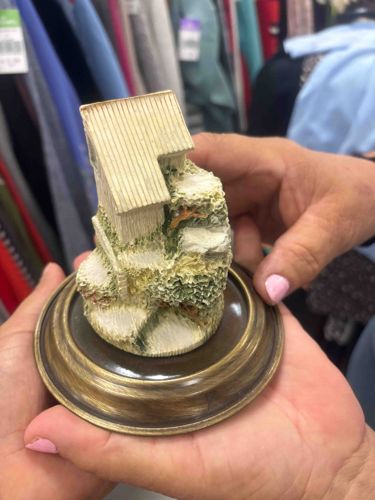
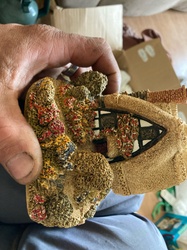
This item is a decorative miniature depicting a small, rustic house or structure built into a rocky, natural landscape. The house itself appears to be made of a light-colored material, possibly resin or a ceramic composite, with details suggesting wooden planks or siding on its sloped roof and walls. The roof has distinct ridged lines, mimicking corrugated metal or closely laid shingle. The surrounding landscape is textured to resemble rock formations and mossy or grassy areas, predominantly in shades of green and off-white/beige. There are sculpted stairs or paths leading up the rocky incline to the house, also in an off-white color. The entire miniature is mounted on a separate, circular base with a raised rim, made of a metallic material, likely brass or a brass-toned alloy, exhibiting a muted, antique-like patina with some subtle striations on its surface. The base shows minor wear consistent with handling. The overall condition appears good with no obvious chips, cracks, or significant damage visible. The color palette is earthy and subdued. The craftsmanship suggests it is a mass-produced collectible or decorative item, likely from the late 20th or early 21st century, given its material and style often associated with home decor miniatures.
AI Appraisal Report
Upon visual examination of the provided image, this Decorative Miniature/Figurine, depicting a rustic house on a rocky landscape with a brass base, appears to be in very good condition. I observe no obvious chips, cracks, or significant damage to the miniature itself or the brass base, which shows only minor, consistent wear. Based on its material appearance—likely resin or a similar composite for the landscape and house, and brass or a brass-toned alloy for the base—its authenticity as a mass-produced decorative item from the late 20th or early 21st century seems consistent with comparable items in the market. The craftsmanship suggests it is not a unique artisan piece but rather a commercially manufactured collectible.
Market conditions for such decorative miniatures are generally stable, with a moderate but not exceptionally high demand. This specific type of item falls into a broad category of home decor collectibles. Comparables found in online marketplaces and specialty antique/vintage stores typically range from $15 to $40 for similar-sized and quality mass-produced resin or composite miniatures on metallic bases. These items are not rare; mass production ensures a plentiful supply.
Factors significantly impacting its value include its condition, which is excellent, and its appeal as a charming decorative piece. However, its mass-produced nature and the current market's ample supply of similar items limit its potential for high valuation. Rarity is low, and demand, while present among collectors of miniatures or specific home decor styles, is not robust enough to drive higher prices.
It is important to state the limitations of this appraisal: full authenticity verification of materials and manufacturing origin cannot be definitively determined from images alone. A physical in-person examination would allow for tactile inspection of materials (e.g., to confirm resin vs. ceramic, or brass alloy composition), assessment of weight, and a thorough check for hairline cracks or repairs not visible in photographs. Provenance documentation, though unlikely for an item of this type, would provide historical context. Scientific testing, such as material analysis, would be needed for absolute confirmation of composition, but is generally reserved for items of significantly higher value.