AI estimate as of November 17, 2025 · verify with a professional before acting
AI-Generated · Verify before acting
Everything on this page is generated by AI for informational purposes only. AI can make mistakes — the AI may misidentify items or misattribute them (artist, maker, brand, designer, origin, era). This is not an official valuation and should not be used for insurance, sale, tax, estate, legal, or lending purposes — or any decision requiring a certified appraisal. It is not an authoritative claim about any person, brand, or rights holder — do not share or rely on it as a factual statement about a third party. Always consult qualified professionals before making financial decisions.
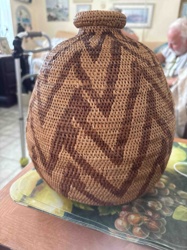
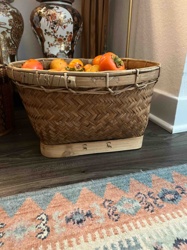
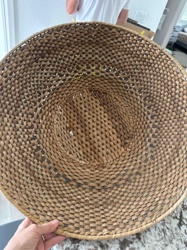
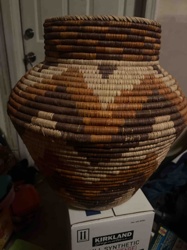
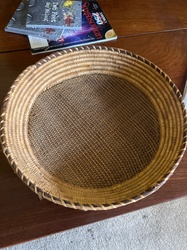
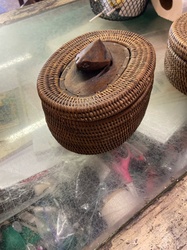
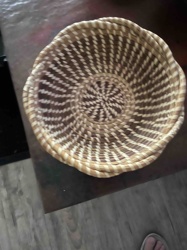
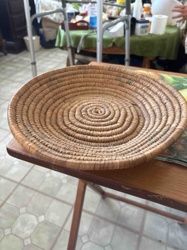
This is a hand-woven coiled basket, likely crafted from natural plant fibers, possibly raffia, cane, or grass. The dominant colors are natural light brown or beige for the background weave, with dark brown or black fibers used to create a striking geometric pattern. The basket has an elongated, cylindrical shape with a slightly tapered, narrower neck and a wider, rounded body, sitting flat at the base. The patterns consist of two primary motifs: a continuous Greek key or meander pattern encircling the upper shoulder of the basket, and repeating vertical columns of 'E'-shaped or stylized fret patterns decorating the main body. The weaving technique appears to be coiled, where a foundation material is spiraled and then sewn together with another fiber, resulting in a durable and textured surface. The craftsmanship suggests a folk art or ethnographic origin, with a visible, uneven texture indicative of hand-made construction. There are no obvious signs of significant damage like major tears or holes, but the fibers show a natural aged patina and minor color variations that are typical for organic materials over time. The rim of the opening appears finished and sturdy. The item appears to be in good, well-preserved condition for its type. Without further information about its origin or maker, it is difficult to determine an exact age, but similar traditional weaving styles have been practiced for centuries across various cultures. This piece exhibits a high level of decorative embellishment through its intricate weaving, indicating skilled artistry.
AI Appraisal Report
I have thoroughly examined the provided image of this hand-woven coiled basket. Visually, the condition appears good, consistent with its age and material. There are no overt signs of significant damage such as tears or holes, although the natural fibers exhibit typical aged patina and minor color variations, which is expected for organic materials. The craftsmanship, particularly the intricate geometric patterns (Greek key and 'E'-shaped motifs), indicates a skilled artisan. This piece certainly has the hallmarks of folk art or ethnographic basketry, likely from natural plant fibers. Without a physical inspection, specific material identification (e.g., raffia, cane) is challenging.
Market conditions for well-crafted, attractive hand-woven baskets with a strong aesthetic are generally stable. Similar ethnographic or decorative coiled baskets, particularly those with strong geometric designs, typically retail in the $200-$500 range, depending heavily on provenance, origin, and specific cultural significance. Demand for unique, hand-crafted decorative arts remains consistent, athough truly rare examples command significantly higher prices. Factors impacting value here include the attractive design, apparent good condition, and skilled execution. Without information on its origin, maker, or age, assessing rarity is difficult.
It is important to note that this appraisal is based solely on visual examination of the image. A full authentication would require in-person inspection to determine the exact fiber composition, confirm the weaving technique without doubt, assess the exact condition more critically (e.g., subtle repairs, pest damage), and potentially verify its age through scientific testing if dating markers were present. Provenance documentation – details of its origin, maker, and history of ownership – would significantly enhance its value and aid in more precise authentication and valuation.