AI estimate as of August 30, 2025 · verify with a professional before acting
AI-Generated · Verify before acting
Everything on this page is generated by AI for informational purposes only. AI can make mistakes — the AI may misidentify items or misattribute them (artist, maker, brand, designer, origin, era). This is not an official valuation and should not be used for insurance, sale, tax, estate, legal, or lending purposes — or any decision requiring a certified appraisal. It is not an authoritative claim about any person, brand, or rights holder — do not share or rely on it as a factual statement about a third party. Always consult qualified professionals before making financial decisions.
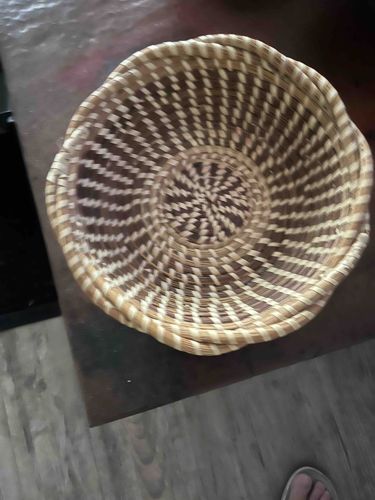
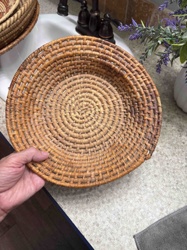
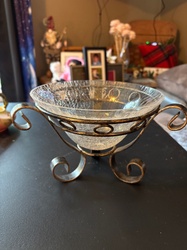
This item is a round, open-top coiled basket, likely hand-woven from natural plant fibers. The primary materials appear to be light tan and dark brown fibers, possibly rush, sweetgrass, or pine needles, given the visible texture and color variations. The basket exhibits a distinctive two-tone pattern, with sections of lighter fibers creating a zigzag or chevron design across the darker background. This pattern radiates outwards from a focal point at the base of the interior, creating a spiral-like effect in the center. The construction method is coiling, where a core material is continuously wrapped with another fiber, forming sequential coils that build up the shape of the basket. The rim of the basket appears to be finished with a thicker, more tightly bound coil, providing structural integrity and a clean edge. The overall form is shallow, suggesting it might be intended as a serving tray, fruit bowl, or decorative centerpiece rather than for deep storage. Visible condition issues include some slight fuzziness or fraying of individual fibers, consistent with age and gentle use, contributing to a natural patina. There are no obvious signs of significant damage, repairs, or missing sections. The craftsmanship appears to be of good quality, with tight coiling and consistent pattern execution, indicating a skilled artisan. Based on the materials and weaving technique, it is likely a vintage or antique piece, possibly dating from the mid-20th century or earlier, and could be indicative of indigenous American basketry traditions or other global artisanal crafts. The specific dimensions are not provided, but it appears to be approximately 10-14 inches in diameter from the visible perspective.
AI Appraisal Report
I have carefully examined the provided image of this Coiled Two-Tone Decorative Basket. My initial assessment is that this is a well-crafted piece of basketry, likely hand-woven from natural plant fibers such as rush, sweetgrass, or pine needles, as evidenced by the texture and color variations. The coiling technique appears consistent and tight, indicative of skilled workmanship. The two-tone zigzag pattern is visually appealing and adds significantly to its aesthetic value.
From the image, the condition appears good for its age. I note only slight fraying of individual fibers, which is consistent with natural aging and gentle use, contributing to a desirable patina. There are no visible signs of major damage, repairs, or missing sections. This excellent preservation enhances its marketability.
Authenticity, based solely on visual examination of an image, is limited. While the weaving style suggests traditional or vintage origins, an in-person examination would be crucial to confirm the specific fiber types, feel the tension of the weave, and inspect for any hidden repairs or machine components that might not be visible. Provenance documentation, such as collection history or maker's marks (if applicable), would also be invaluable for definitive authentication and to potentially tie it to a specific artisan or indigenous group. Without such documentation, attributing it to a particular period or cultural tradition is speculative.
In terms of market conditions, vintage and artisanal basketry generally see steady demand, particularly pieces with attractive patterns and good condition. Comparables in the market for well-preserved, hand-coiled decorative baskets of this size range typically fetch between $150 and $300. Pieces with verifiable provenance, particularly those attributed to renowned artisans or specific indigenous communities, can command significantly higher prices. Rarity is difficult to ascertain without more information, but the unique pattern offers some distinction. The lack of definitive provenance prevents me from assigning a higher value that might be typical for documented antique or indigenous pieces. Therefore, my appraisal value reflects its decorative quality and good condition as a vintage folk art object, without the premium of confirmed provenance or age.