AI Appraisal Estimate

AI-generated estimates · not official valuations

From the user

What was submitted

Photo and notes provided by the user — not generated by AI

Submitted item photo
Submitted photo · July 12, 2026

User's notes

No additional notes provided.

AI analysis below

AI appraisal

AI analysis & estimate

AI-Generated · Verify before acting

Everything below is generated by AI for informational purposes only. AI can make mistakes — the AI may misidentify items or misattribute them (artist, maker, brand, designer, origin, era). This is not an official valuation and should not be used for insurance, sale, tax, estate, legal, or lending purposes — or any decision requiring a certified appraisal. It is not an authoritative claim about any person, brand, or rights holder — do not share or rely on it as a factual statement about a third party. Always consult qualified professionals before making financial decisions.

Read the full disclaimer

AI Identification

·Not independently authenticated·Verify before acting

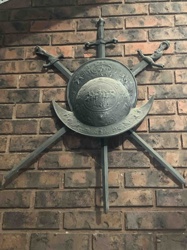
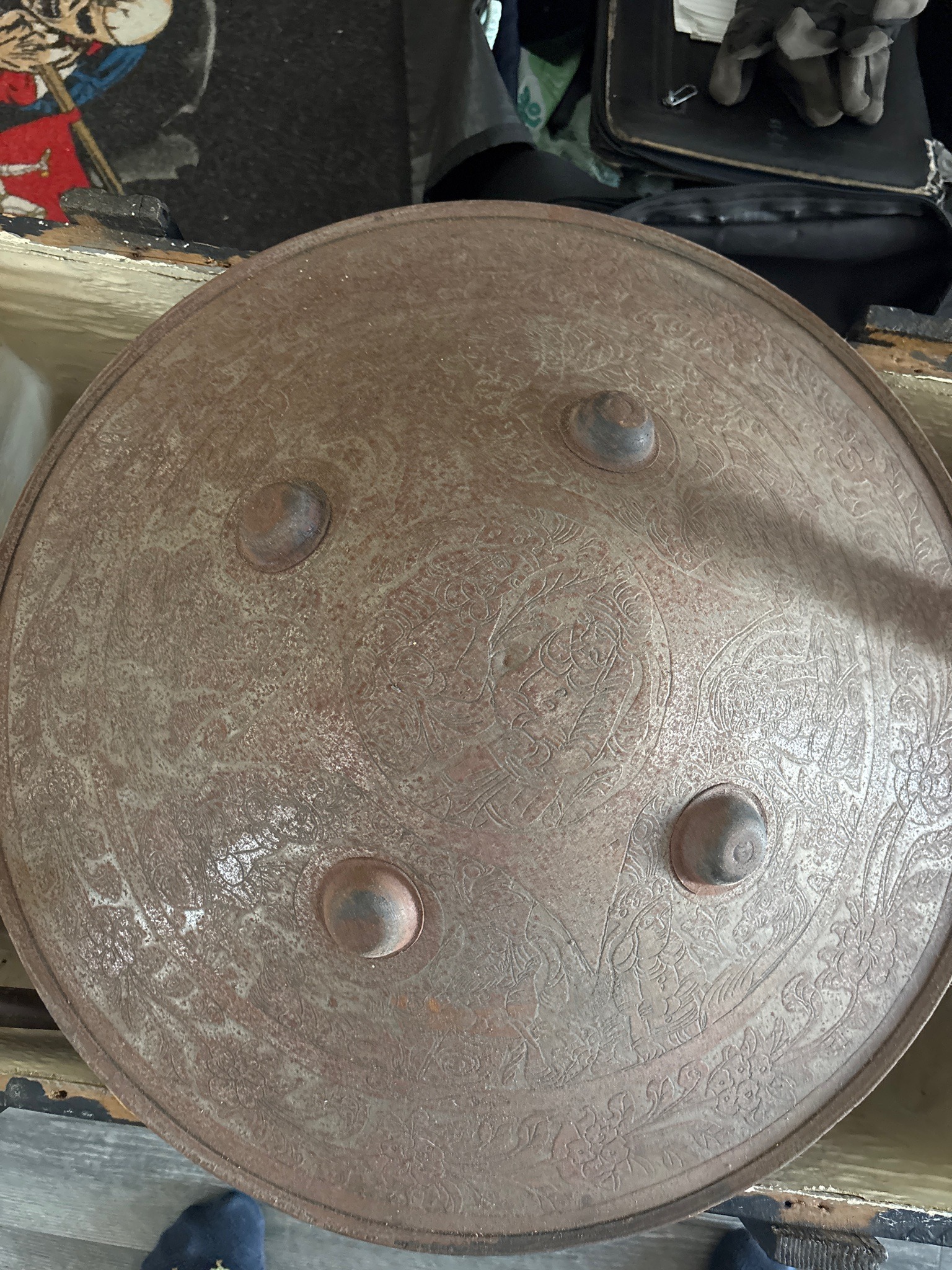
Indo-Persian style engraved metal shield

Armor and Militaria

AI Estimated Value

·Not an official valuation·Verify before acting

$400 - $1,200

As of July 12, 2026

AI Item Analysis

·AI can make mistakes·Verify before acting
This appears to be a circular convex shield, stylistically consistent with Indo-Persian 'dhal' shields. The item is constructed from a dark metal, potentially iron or steel, and features four prominent raised conical bosses or umbos arranged symmetrically around the center. These bosses typically serve as mounting points for handle straps on the reverse. The entire surface is densely decorated with fine engravings including floral motifs, scrolling arabesques, and what appear to be figurative or calligraphic elements in the central medallion and outer border. The design is consistent with the ornamental metalwork of the 18th or 19th centuries from the Indian subcontinent or Persia, though it could be a later commemorative or decorative piece. Condition-wise, the shield shows significant surface oxidation, rust, and a heavy patina throughout, which obscures the finer details of the engraving. There are no clearly visible maker's marks or signatures in the image; therefore, this identification remains a hypothesis based on visible form, ornamentation, and construction. Any specific age or origin would require physical inspection for metallurgical analysis.
AI Appraisal Report

·AI can make mistakes·Verify before acting
Based on my visual examination of the provided image, I have evaluated this circular convex shield as being stylistically consistent with an Indo-Persian 'dhal.' The item features four conical bosses and dense engraving including floral and figurative motifs. From what I can see, the heavy surface oxidation and patina are consistent with an 18th or 19th-century origin, though I cannot verify the exact age or metallurgical composition from a photograph alone. This identification remains a working hypothesis. The value is based on the assumption that this is a period-constructed piece; however, without a physical inspection to check the weight, construction technique, and metal purity, it is impossible to determine if this is a high-quality period armament or a later 20th-century decorative reproduction. The market for Indo-Persian militaria is generally robust, but values are highly dependent on the quality of the 'koftgari' or engraving and the condition of the metal. The significant rust and obscured details noted here suggest a lower-to-mid range for a period piece. To confirm the origin and value, one would need an in-person examination by a specialist, provenance documentation, and potentially scientific testing to analyze the iron/steel. If this item is found to be a modern 20th-century replica or 'in the style of' piece intended for the tourist trade, the value would likely decrease to the $100-$200 range. Conversely, if cleaning reveals high-quality silver or gold inlay (koftgari) currently hidden by oxidation, the value could exceed the current estimate. I have appraised this under the assumption of it being a period-relevant decorative object in fair-to-poor condition.

Get your items appraised

Instant estimates of your treasures with AI-powered appraisals

Browse More Appraisals