AI Appraisal Estimate

AI-generated estimates · not official valuations

From the user

What was submitted

Photo and notes provided by the user — not generated by AI

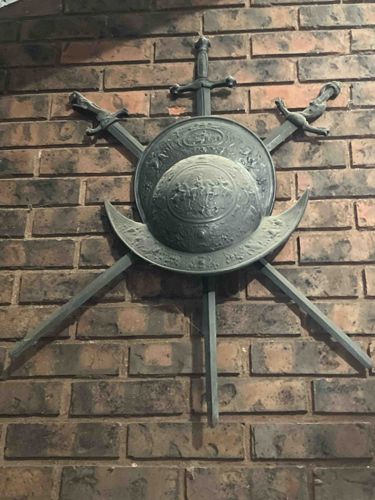
Submitted item photo
Submitted photo · June 8, 2026

User's notes

No additional notes provided.

AI analysis below

AI appraisal

AI analysis & estimate

AI-Generated · Verify before acting

Everything below is generated by AI for informational purposes only. AI can make mistakes — the AI may misidentify items or misattribute them (artist, maker, brand, designer, origin, era). This is not an official valuation and should not be used for insurance, sale, tax, estate, legal, or lending purposes — or any decision requiring a certified appraisal. It is not an authoritative claim about any person, brand, or rights holder — do not share or rely on it as a factual statement about a third party. Always consult qualified professionals before making financial decisions.

Read the full disclaimer

AI Identification

·Not independently authenticated·Verify before acting

Decorative Heraldic Shield and Sword Wall Plaque

Home Decor / Militaria Collectibles

AI Estimated Value

·Not an official valuation·Verify before acting

$45-75

As of June 8, 2026

AI Item Analysis

·AI can make mistakes·Verify before acting
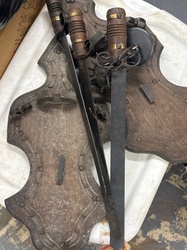
This is a decorative cast-metal wall display featuring a central round shield (rotella) set against a backdrop of three crossed swords. The set appears to be constructed from cast aluminum or a similar pot metal with a dark, faux-verdigris or antiqued bronze finish. The shield features a prominent central boss with a raised relief scene depicting classical or mythological figures, surrounded by an outer rim with additional relief friezes. Below the shield is a crescent-shaped attachment, also decorated with figural reliefs. The three swords include a vertically oriented central blade and two diagonal blades, each featuring ornate hilts with double-quillon crossguards and decorative pommels. One hilt appears to have a slight bend or misalignment. The surface exhibits a heavy patina of dust and oxidation consistent with long-term indoor display. The overall style is a 20th-century neo-Renaissance or 'Cavalier' revival piece, likely manufactured as interior decor between 1950 and 1980 rather than being functional weaponry. The craftsmanship shows typical characteristics of industrial sand-casting with some loss of fine detail in the relief work.
AI Appraisal Report

·AI can make mistakes·Verify before acting
I have examined the digital image of the decorative heraldic wall display. Based on my visual analysis, this is a mid-to-late 20th-century 'Cavalier' style decorator piece, likely produced between 1960 and 1980. The casting displays hallmarks of industrial mass-production, specifically sand-cast aluminum or base 'pot metal.' The faux-bronze/verdigris finish and the simplified, rounded edges of the relief work confirm this is an ornamental item rather than a functional or period piece. The condition is fair to good. There is significant accumulated dust and surface oxidation. I noted a structural misalignment in one of the diagonal sword hilts, suggesting the metal is soft and susceptible to bending. This type of damage is common for decorative cast metal. Such items were widely produced by companies like Sexton or Italian export firms for the suburban home decor market. Market demand for this specific style of 'medieval-revival' militaria is currently low, as modern interior design trends have shifted away from heavy, faux-classical metalwork. Comparable items frequently sell at estate auctions and online marketplaces (such as eBay or Etsy) for under $100. The primary value lies in its aesthetic utility as a prop or thematic decor. Limitations: This appraisal is based solely on digital imagery. To verify the metal composition, a physical 'scratch test' or XRF analysis would be required. In-person inspection would also determine if any components are resin-based rather than metal. No provenance was provided; however, given the manufacturing style, historical documentation would not significantly alter the valuation. True 17th-century pieces would require metallurgical testing and provenance tracing to prove age and authenticity.

Get your items appraised

Instant estimates of your treasures with AI-powered appraisals

Browse More Appraisals