AI estimate as of September 12, 2025 · verify with a professional before acting
AI-Generated · Verify before acting
Everything on this page is generated by AI for informational purposes only. AI can make mistakes — the AI may misidentify items or misattribute them (artist, maker, brand, designer, origin, era). This is not an official valuation and should not be used for insurance, sale, tax, estate, legal, or lending purposes — or any decision requiring a certified appraisal. It is not an authoritative claim about any person, brand, or rights holder — do not share or rely on it as a factual statement about a third party. Always consult qualified professionals before making financial decisions.
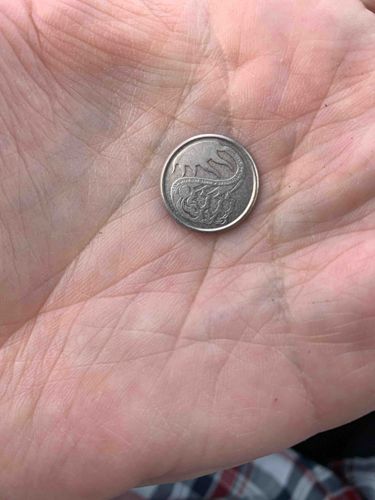
The item is a silver-colored, circular metal coin, appearing to be approximately 28 to 30 millimeters in diameter, given its size relative to the palm it rests upon. The observable side of the coin features an embossed design of a platypus, a common motif found on Australian coinage. The platypus is rendered in a naturalistic style, with clear details on its bill, eyes, and the texture of its fur, leading into its distinctive tail. Below the platypus, there are what appear to be ripples or water currents, indicating its aquatic habitat. The design is centrally placed within a raised rim around the circumference of the coin. The metal itself shows a slightly dulled, matte finish with some subtle reflections, suggesting it's made of a base metal alloy, likely cupronickel, as is common for this denomination. There are no significant signs of heavy wear, deep scratches, or major damage, though minor surface abrasions consistent with circulation are likely present but not clearly discernible from the image. The overall condition appears to be good to very good, with the design elements remaining distinct and well-preserved. There are no visible maker's marks, mint stamps, or numerical value on this side, which is consistent with the standard design of the Australian 20-cent coin where such information is typically on the obverse (not visible here). The craftsmanship appears to be of standard mint quality, with sharp lines and relief in the design. The style is modern numismatic, typical of coins issued after the mid-20th century.
AI Appraisal Report
I have examined the provided image of what appears to be an Australian 20-Cent Coin featuring the Platypus design. Based on its visual characteristics, it presents as an authentic piece of Australian coinage. The design elements, including the platypus with its distinctive features and the aquatic ripples, align perfectly with the standard reverse design for this denomination. The estimated diameter of 28-30mm is consistent with the specified coin. The dull, matte finish and subtle reflections suggest the typical cupronickel composition.
From the image, the coin's condition appears good to very good, showing no significant damage, heavy wear, or deep scratches that would dramatically diminish its value. Minor surface abrasions are likely present, as expected for a circulating coin, but are not clearly discernible enough to classify a precise uncirculated grade.
Australian 20-cent coins with the platypus design are common and have been minted in large quantities for decades. They do not possess inherent rarity unless they are a specific key date, a low-mintage year, or a high-grade uncirculated specimen (MS-65 or higher) from an earlier year, none of which can be determined from this single reverse image. Market demand for common circulating Australian coinage is generally low, with most collectors seeking higher-grade examples or rarer varieties.
Therefore, without any distinguishing features visible, the primary factor impacting its value is its face value. However, a coin in good condition might fetch a small premium from a beginner collector or as part of a bulk lot. Without inspecting the obverse (which would show the monarch's effigy and the mint year), examining the coin under magnification for specific mint marks, or verifying its weight and precise dimensions, it is impossible to determine if it is a rarer variety, a proof strike, or a high-grade early issue. Full authentication and a more precise grading would necessitate an in-person examination by a numismatist to assess luster, exact surface imperfections, and confirm all specific details.