These notes were written by the person who submitted this item. Appraiser.AI has not verified them, and the AI's identification and estimate may rely on them.
AI Estimated Value
Not an official valuation
$75-150
AI estimate as of September 11, 2025 · verify with a professional before acting
AI-Generated · Verify before acting
Everything on this page is generated by AI for informational purposes only. AI can make mistakes — the AI may misidentify items or misattribute them (artist, maker, brand, designer, origin, era). This is not an official valuation and should not be used for insurance, sale, tax, estate, legal, or lending purposes — or any decision requiring a certified appraisal. It is not an authoritative claim about any person, brand, or rights holder — do not share or rely on it as a factual statement about a third party. Always consult qualified professionals before making financial decisions.
This analysis also relies on unverified notes provided by the user, which may be incomplete or inaccurate and could affect the result.
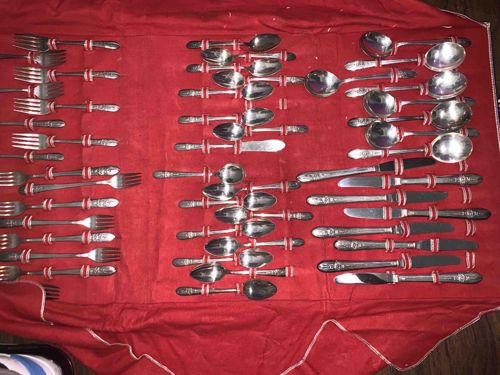
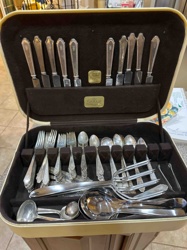
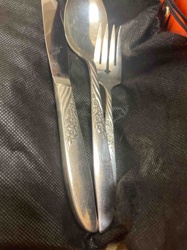
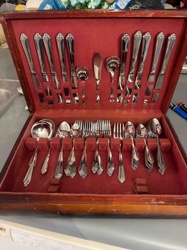
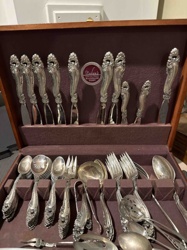
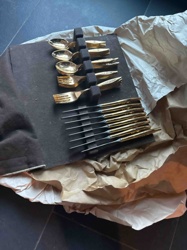
This is a comprehensive flatware set, likely silver-plated, manufactured by Wm. Rogers Mfg. Co. under their "Extra Plate" and "Original Rogers" lines. The set consists of various pieces, including multiple sizes of forks (dinner and salad/dessert forks), spoons (teaspoons, soup spoons, and possibly serving spoons), and knives. Each piece appears to be crafted from a silver-colored metal, likely electroplated nickel silver or a similar alloy, given the "Extra Plate" designation, which typically indicates a heavier plating than standard. The handles of the flatware feature an ornate, possibly floral or scrolled, decorative pattern, indicative of a late 19th to early 20th-century aesthetic, perhaps Victorian or Edwardian revival. The knives have distinct dark handles, likely made of Bakelite, Celluloid, or a similar early plastic, attached to the metal blade and bolster section, which is a common construction for knives of this period. The overall condition appears good, with some visible patina consistent with age and use, but no obvious signs of significant damage like heavy dents, bends, or missing pieces. Some surface scratches might be present from regular handling and cleaning. The set is neatly organized within a vibrant red fabric storage roll or case, with individual slots and elastic bands (red and white striped) to secure each utensil, protecting them from scratching and tarnishing. The storage roll itself shows some signs of use, possibly minor fading or wear on the edges, but remains functional for protective storage. The craftsmanship appears to be of good commercial quality for its time, typical of mass-produced silver-plated goods intended for middle-class homes.
AI Appraisal Report
Upon examination of the provided image and information regarding this Wm. Rogers Mfg. Co. 'Extra Plate' flatware set, I assess its condition as good, consistent with its likely age (late 19th to early 20th century). The 'Extra Plate' and 'Original Rogers' markings confirm authenticity as a product of the Wm. Rogers line, a prominent silverplate manufacturer. The visible patina and lack of major structural damage suggest a well-preserved, though used, set. The distinct dark handles on the knives are typical of the period, likely Bakelite or Celluloid, and common for such sets. The red storage roll, while showing some wear, is functional and adds to the presentation.
From a market perspective, silver-plated flatware, even from well-known manufacturers like Wm. Rogers, generally has a modest value compared to sterling silver. The market for vintage silver plate is often driven by decorative appeal and utility rather than intrinsic material value. Comparables indicate that complete silverplate sets with their original storage can fetch more than individual pieces, but demand remains stable rather than high. Factors impacting value include the number of pieces, the specific pattern (though ornate patterns are common), and the overall condition of the plating. Extensive wear, pitting, or loss of plating would significantly reduce value, none of which are definitively visible here, but require in-person inspection.
Limitations in authenticity verification from images alone include the inability to fully assess plate integrity (e.g., wear-through to base metal), the precise material composition of the knife handles without scratch testing, or to identify any subtle repairs or hidden damage. A physical examination would allow for a complete count of all pieces, a thorough inspection of the plating on each utensil under varying light, and a closer look at the storage roll’s overall condition. Provenance documentation, if available, could confirm the set's history and add context, though it's less critical for mass-produced silverplate.