AI estimate as of September 28, 2025 · verify with a professional before acting
AI-Generated · Verify before acting
Everything on this page is generated by AI for informational purposes only. AI can make mistakes — the AI may misidentify items or misattribute them (artist, maker, brand, designer, origin, era). This is not an official valuation and should not be used for insurance, sale, tax, estate, legal, or lending purposes — or any decision requiring a certified appraisal. It is not an authoritative claim about any person, brand, or rights holder — do not share or rely on it as a factual statement about a third party. Always consult qualified professionals before making financial decisions.
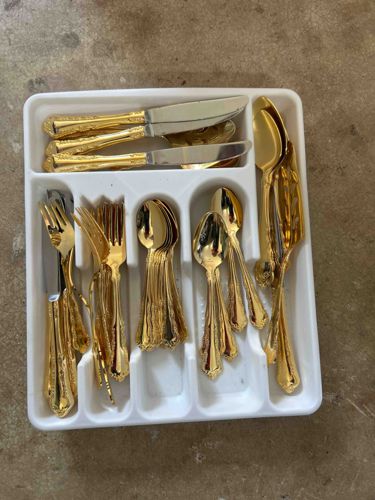
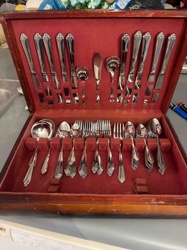
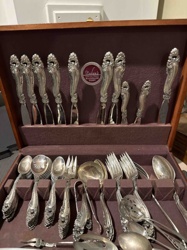
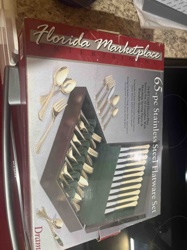
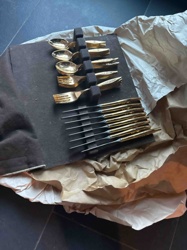
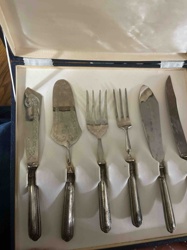
This item is a gold-toned flatware collection, likely a full set or a significant portion thereof, displayed in a white plastic drawer organizer. The set appears to be made from a base metal, possibly stainless steel, with a gold plating or PVD coating, giving it a rich, reflective appearance. The handles of all visible pieces (knives, forks, and spoons) feature an elaborate, possibly rococo or Victorian-inspired, embossed or engraved decorative pattern, characterized by scrolls, floral motifs, and other ornate detailing. The knives are particularly distinctive, with polished silver-tone blades contrasting sharply with their gold-toned, decorated handles. The forks and spoons are entirely gold-toned, showcasing the same intricate handles. There are multiple sizes of spoons, including presumed teaspoons and possibly larger serving spoons, and various fork types. While no specific maker's marks or signatures are visible, the consistent decorative pattern across all pieces suggests they belong to a matched set. The overall condition appears to be relatively good, with no obvious signs of heavy tarnishing, significant wear to the gold finish, or bending/damage to the tines or bowls from the visible angles. The flatware is neatly arranged within a standard white, multi-compartment plastic tray, designed for silverware storage within a drawer. The style points toward a decorative, perhaps more formal or festive, dinnerware aesthetic, possibly from the mid to late 20th century given the commonality of gold-toned settings in that era. The craftsmanship, indicated by the detailed handle work, suggests a moderate to good quality set intended for regular use or special occasions.
AI Appraisal Report
This gold-toned flatware set, presented in a plastic organizer, appears to be in good overall condition based on visual inspection. The gold plating or PVD coating shows no obvious signs of significant wear, tarnish, or damage, and the intricate rococo or Victorian-inspired detailing on the handles is well-preserved. The contrast between the silver-tone knife blades and the gold handles is striking and adds to the decorative appeal. Authenticity, based solely on visual evidence, suggests it is a complete, matched set as indicated by the consistent decorative pattern across all pieces.
Market conditions for gold-toned flatware are generally moderate. While not as universally sought after as traditional silver or stainless steel, there is a niche market for decorative sets, especially for special occasions or those looking to add a vintage aesthetic to their dining experience. Demand for such sets is not exceptionally high, nor is it particularly rare, as many manufacturers produced similar styles in the mid to late 20th century.
Factors impacting value include the good perceived condition and the completeness of the set. However, authenticity cannot be fully verified without in-person examination. For a more definitive appraisal, I would require a physical inspection to:
1. Ascertain the base metal composition and the quality of the gold finish (plating thickness, PVD application).
2. Search for any hidden manufacturer's marks or hallmarks, which could significantly impact value if from a renowned maker.
3. Assesses the true extent of wear, particularly on high-contact areas, and test the integrity of the finish.
Provenance documentation or scientific testing (e.g., XRF analysis for metal composition) would be needed for absolute authentication of material quality and origin beyond what is visually apparent.