AI Appraisal Estimate

AI-generated estimates · not official valuations

From the user

What was submitted

Photo and notes provided by the user — not generated by AI

Submitted item photo
Submitted photo · May 26, 2026

User's notes

No additional notes provided.

AI analysis below

AI appraisal

AI analysis & estimate

AI-Generated · Verify before acting

Everything below is generated by AI for informational purposes only. AI can make mistakes — the AI may misidentify items or misattribute them (artist, maker, brand, designer, origin, era). This is not an official valuation and should not be used for insurance, sale, tax, estate, legal, or lending purposes — or any decision requiring a certified appraisal. It is not an authoritative claim about any person, brand, or rights holder — do not share or rely on it as a factual statement about a third party. Always consult qualified professionals before making financial decisions.

Read the full disclaimer

AI Identification

·Not independently authenticated·Verify before acting

Vintage Sterling Silver Flatware Set in Naken’s Tarnish Proof Chest

Antique Tableware & Silver

AI Estimated Value

·Not an official valuation·Verify before acting

$1,800 - $3,200

As of May 26, 2026

AI Item Analysis

·AI can make mistakes·Verify before acting
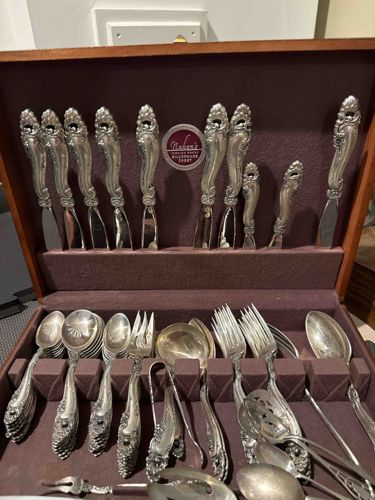
This is a comprehensive multi-piece flatware service featuring a highly ornate, Rococo-style scrolling floral and foliate pattern. The set is displayed within a vintage 'Naken’s Tarnish Proof Silverware Chest' lined with tarnish-resistant mauve felt. The collection includes a diverse array of serving and place pieces, such as dinner forks with long tines, rounded soup spoons, teaspoons with shell-shaped heels, butter knives with stainless blades, and specialty items like sugar tongs and pierced serving spoons. The handles exhibit high-relief casting with intricate scrollwork and scalloped edges, characteristic of mid-20th-century silver flatware designs. While a specific maker's mark is not visible in the focal distance, the pattern style is consistent with renowned American silversmiths like Wallace (e.g., Grand Baroque) or Gorham (e.g., Chantilly variants). The condition shows light to moderate patina and surface oxidation, particularly on the spoons in the lower tray, which is typical for sterling silver. The wooden chest appears to be in good structural condition with the original manufacturer's label intact on the inner lid. This set represents high-quality craftsmanship through its heavy gauge construction and detailed ornamental die-work, likely dating from the 1940s to 1960s.
AI Appraisal Report

·AI can make mistakes·Verify before acting
Based on my visual examination of the digital images provided, this appears to be a substantial sterling silver flatware service, likely dating to the mid-20th century (1940s-1960s). The set is housed in a Naken’s Tarnish Proof Chest, which, while not adding significant financial value, speaks to the care the set has received. The pattern exhibits high-relief Rococo-style scrollwork reminiscent of Wallace’s 'Grand Baroque' or similar heavy-weight patterns by Gorham or Reed & Barton. The presence of specialized pieces like sugar tongs and pierced servers suggests a comprehensive service for 8 to 12. Condition-wise, the silver shows typical oxidation and tarnish, which is expected and easily remedied. The blades appear intact, though separation at the bolster is a common age-related issue to watch for. The market for sterling flatware fluctuates daily based on the spot price of silver (scrap value) versus the collector premium for desirable patterns. Currently, demand for ornate, heavy-gauge patterns remains steady, often commanding 20-40% above melt value. However, without physically weighing the set to determine the total troy ounce weight of weighable silver (excluding weighted knives and reinforced handles), a precise valuation is difficult. Limitations: My appraisal assumes the pieces are solid sterling silver (.925) rather than silver plate. Authentication requires locating the 'Sterling' stamp and maker's mark on the reverse of the stems. Physical inspection is also necessary to detect monogram removals or deep pitting which would devalue the set. If this is a premium pattern like 'Grand Baroque,' the value leans toward the higher end; generic floral patterns will adhere closer to scrap value.

Get your items appraised

Instant estimates of your treasures with AI-powered appraisals

Browse More Appraisals