AI estimate as of November 30, 2025 · verify with a professional before acting
AI-Generated · Verify before acting
Everything on this page is generated by AI for informational purposes only. AI can make mistakes — the AI may misidentify items or misattribute them (artist, maker, brand, designer, origin, era). This is not an official valuation and should not be used for insurance, sale, tax, estate, legal, or lending purposes — or any decision requiring a certified appraisal. It is not an authoritative claim about any person, brand, or rights holder — do not share or rely on it as a factual statement about a third party. Always consult qualified professionals before making financial decisions.
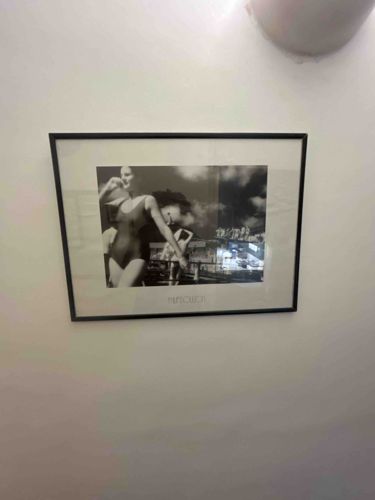
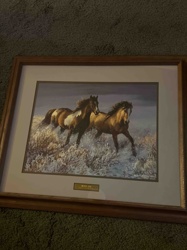
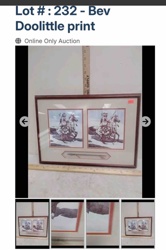
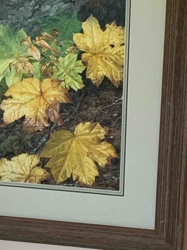
The item is a framed black and white photographic print, depicting a scene with at least two figures foregrounded against a dramatic, cloudy sky and what appears to be a city or industrial landscape in the background. The primary figure visible is a woman in what resembles a swimsuit or leotard, exhibiting a dynamic pose with her body leaning forward and to the right, arms extended. Her head is partially obscured by another element or figure. The overall aesthetic of the photograph suggests a fine art or conceptual photography style, possibly from the mid-to-late 20th century due to its monochromatic nature and composition. The print is housed within a simple, rectangular black frame, likely made of wood or a composite material, with a narrow profile. A white mat border separates the print from the frame, providing visual breathing room and protection. There appears to be a glare on the glass or acrylic covering the print, making it difficult to discern fine details or any potential signatures or edition numbers directly on the photograph itself. Below the main image, centered on the white border, a word or name, possibly 'MERCURIAL' or a similar, partially visible text, is printed in capital letters. The frame itself appears to be in good condition, with no obvious chips or damage discernible from the image. The print itself seems well-preserved under the glazing, though assessing its pristine condition without direct inspection is challenging due to lighting and resolution. The craftsmanship of the framing appears utilitarian but effective, typical for display pieces. The photograph demonstrates a strong contrast between light and shadow, characteristic of black and white photography, and evokes a sense of narrative or emotional depth.
AI Appraisal Report
Upon visual examination of the provided image, I assess this framed black and white photographic print. The print itself appears to be in good condition, well-protected behind glazing, though glare prevents a definitive assessment of minor surface imperfections or the precise tonal range. The framing, a simple black profile with a white mat, is utilitarian and effective, showing no visible damage. The overall aesthetic suggests a fine art conceptual piece, likely mid-to-late 20th century. The visible text 'MERCURIAL' on the mat could be a title or artist's name, significantly impacting value if it points to a recognized artist.
From images alone, authenticating the artist, edition status, or even print method (e.g., gelatin silver, archival inkjet) is impossible. Without provenance documentation, a signature, or edition numbers, it's difficult to ascertain rarity. Demand for fine art photography varies widely based on the artist's reputation, the print's historical significance, and its condition. Comparables for unsigned, uneditioned fine art prints by unknown photographers would typically fall into the lower end of the contemporary art market.
For full authentication and a more precise valuation, an in-person examination is crucial. This would allow me to inspect the print's surface for damage, assess the paper type and photographic process, and look for any hidden signatures, edition stamps, or artist's marks. Verification of the artist and exhibition history through provenance documents (e.g., certificates of authenticity, gallery receipts) would also be essential. Given the information available, the appraisal reflects a fine art print of good presentation but unconfirmed authorship or rarity.