AI Appraisal Estimate

AI-generated estimates · not official valuations

From the user

What was submitted

Photo and notes provided by the user — not generated by AI

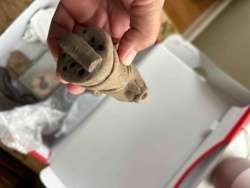
Submitted item photo
Submitted photo · May 23, 2026

User's notes

No additional notes provided.

AI analysis below

AI appraisal

AI analysis & estimate

AI-Generated · Verify before acting

Everything below is generated by AI for informational purposes only. AI can make mistakes — the AI may misidentify items or misattribute them (artist, maker, brand, designer, origin, era). This is not an official valuation and should not be used for insurance, sale, tax, estate, legal, or lending purposes — or any decision requiring a certified appraisal. It is not an authoritative claim about any person, brand, or rights holder — do not share or rely on it as a factual statement about a third party. Always consult qualified professionals before making financial decisions.

Read the full disclaimer

AI Identification

·Not independently authenticated·Verify before acting

Etched Brass Tibetan Singing Bowl

Cultural Artifacts and Musical Instruments

AI Estimated Value

·Not an official valuation·Verify before acting

$40 - $80

As of May 23, 2026

AI Item Analysis

·AI can make mistakes·Verify before acting
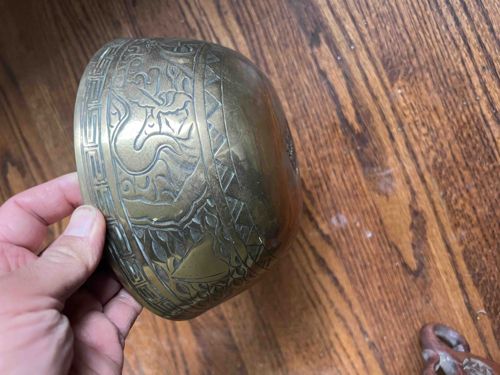
This is a hand-crafted metal alloy singing bowl, predominantly composed of brass with a warm golden hue. The exterior is intricately decorated with multiple bands of etched and chased ornamentation. Around the rim, there is a classic Greek key or 'meander' geometric border. The central body of the bowl features a wide register containing highly stylized floral and leaf motifs, possibly representing lotus blossoms, which are significant in Himalayan art. This is followed by a narrow band of repeating geometric triangles. The bowl is hemispherical with a rounded bottom and a slightly inverted rim. Regarding its condition, the piece shows a significant aged patina with darkening in the recessed areas of the engraving, which helps define the pattern. There are visible surface scratches, minor indentations, and areas of oxidation consistent with age and regular use. The tool marks within the etched sections suggest hand-work rather than machine precision. While no specific maker’s mark is visible in this orientation, the style and craftsmanship are characteristic of mid-20th-century Himalayan or Tibetan exports. Its acoustic quality is likely clear and resonant, a hallmark of this specific bell-metal construction.
AI Appraisal Report

·AI can make mistakes·Verify before acting
Based on my visual examination of this etched brass singing bowl, I assess it to be a mid-to-late 20th-century commercial export piece, likely originating from Nepal or Northern India rather than being an antique ritual artifact. The craftsmanship displays the characteristic 'etched' style where patterns are darkened with a black pigment or oxidation to contrast against the polished brass alloy. While the description notes hand-tooling, the uniformity of the 'Greek key' rim and the stylized floral registers suggests standard workshop production aimed at the tourist or spiritual wellness market rather than high-end artisan metalwork. The condition appears consistent with moderate use; the surface scratches and oxidation add a pleasant aesthetic patina but do not necessarily indicate significant age (pre-1900). True antique singing bowls often feature much simpler, hand-beaten surfaces without such elaborate, decorative etching. The heavy ornamentation seen here is a stylistic marker of pieces produced from the 1960s onwards. Market demand for singing bowls remains steady, driven by the yoga and sound therapy communities. However, values are heavily bifurcated: true antiques command hundreds or thousands, while decorative vintage examples like this realize modest sums. This bowl falls into the latter category—a functional, attractive instrument but not a rare collector's item. A definitive authentication would require an in-person acoustic test to sustain the tone (sustain is a key quality indicator) and metallurgical analysis to determine the specific alloy mixture, as high-quality 'seven-metal' bowls command premiums over standard brass. Without provenance linking this to a specific monastery or early collection, it is appraised as a vintage decorative musical instrument.

Get your items appraised

Instant estimates of your treasures with AI-powered appraisals

Browse More Appraisals