AI estimate as of September 7, 2025 · verify with a professional before acting
AI-Generated · Verify before acting
Everything on this page is generated by AI for informational purposes only. AI can make mistakes — the AI may misidentify items or misattribute them (artist, maker, brand, designer, origin, era). This is not an official valuation and should not be used for insurance, sale, tax, estate, legal, or lending purposes — or any decision requiring a certified appraisal. It is not an authoritative claim about any person, brand, or rights holder — do not share or rely on it as a factual statement about a third party. Always consult qualified professionals before making financial decisions.
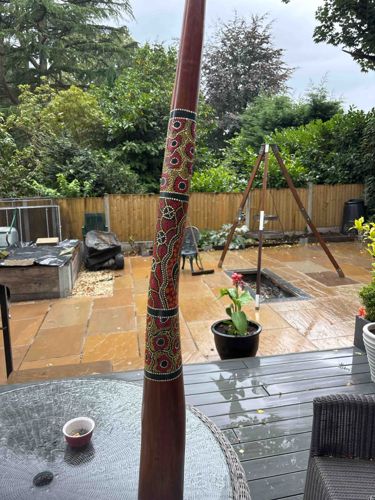
This appears to be a traditional Aboriginal didgeridoo, a wind instrument, characterized by its elongated, conical or cylindrical shape. The instrument is crafted from what looks like a single piece of wood, likely eucalyptus, given its common use for didgeridoos. It has a rich, reddish-brown natural wood finish on the upper and lower sections, which appears to be polished or sealed. The central portion of the didgeridoo is adorned with vibrant, traditional Aboriginal dot painting, featuring intricate patterns and symbols. The colors used in the artwork are predominantly red, black, and yellow/gold, carefully applied in a dot art style that creates distinct circular and linear motifs. Two main decorated bands are visible, separated by a plain black band. The craftsmanship of the dot painting suggests it is hand-applied, indicating a degree of artistic skill. There are no immediately obvious signs of severe damage, cracks, or repairs, though some minor surface wear might be present consistent with age and handling. The overall condition appears good, with the colors of the artwork remaining bright and intact. No discernible maker's marks or signatures are visible in the provided image. The style of decoration strongly suggests an origin in Australian Aboriginal culture, likely a contemporary piece made for sale rather than a ceremonial object. The size appears substantial, indicating it would produce deep resonant sounds characteristic of the instrument. The wood shows a natural grain and texture, and the surface appears smooth under the artwork.
AI Appraisal Report
Having carefully examined the provided image of this Aboriginal Dot Painted Didgeridoo, I find its overall condition to be good. There are no apparent major cracks, repairs, or significant cosmetic damage visible. The wood appears well-preserved, and the dot painting, vibrant with traditional red, black, and yellow/gold colors, seems intact and well-executed. The artistry suggests a hand-painted piece, which adds to its aesthetic appeal. However, it is crucial to note that assessing authenticity from images alone has significant limitations. While it strongly resembles a contemporary, tourist-market didgeridoo, true Aboriginal ceremonial pieces or historically significant artifacts would require rigorous in-person examination.
From a market perspective, contemporary Aboriginal art and didgeridoos, especially those made for the broader market rather than internal community use, are relatively common. Factors impacting value include the quality of the artwork, the type of wood, and the craftsmanship. This piece appears to be made from a suitable wood, likely eucalyptus, and the painting is of decent quality for this market segment. Demand for such instruments is steady but not exceptionally high, and rarity is not a factor for these contemporary items. Without provenance, artist signature, or detailed information on its origin, it's difficult to distinguish it from many similar pieces available.
For full authentication, especially if claiming traditional or ceremonial significance, I would require physical inspection to assess the wood type, age, and construction methods more precisely. Microscopic analysis of the paint could confirm traditional natural pigments versus modern acrylics. Furthermore, provenance documentation, such as certificates of authenticity from a recognized Aboriginal art center or an established gallery, and verification of the artist's identity and community affiliation, would be essential. Without these, it is appraised as a decorative and functional musical instrument rather than a significant art historical artifact.