AI Appraisal Estimate

AI-generated estimates · not official valuations

From the user

What was submitted

Photo and notes provided by the user — not generated by AI

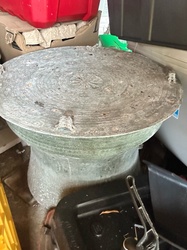
Submitted item photo
Submitted photo · June 13, 2026

User's notes

No additional notes provided.

AI analysis below

AI appraisal

AI analysis & estimate

AI-Generated · Verify before acting

Everything below is generated by AI for informational purposes only. AI can make mistakes — the AI may misidentify items or misattribute them (artist, maker, brand, designer, origin, era). This is not an official valuation and should not be used for insurance, sale, tax, estate, legal, or lending purposes — or any decision requiring a certified appraisal. It is not an authoritative claim about any person, brand, or rights holder — do not share or rely on it as a factual statement about a third party. Always consult qualified professionals before making financial decisions.

Read the full disclaimer

AI Identification

·Not independently authenticated·Verify before acting

Anthropomorphic Pre-Columbian Style Terracotta Flute or Whistle

Archaeological Artifacts / Musical Instruments

AI Estimated Value

·Not an official valuation·Verify before acting

$150 - $350

As of June 13, 2026

AI Item Analysis

·AI can make mistakes·Verify before acting
This item is a small, hand-modeled ceramic wind instrument, likely an ocarina or whistle, crafted in a style reminiscent of Pre-Columbian West Mexican or Central American traditions. It is approximately 3 to 4 inches in length, constructed from a buff-colored, unglazed earthenware clay. The object features a distinct anthropomorphic or zoomorphic design, with a stylized face modeled at one end characterized by sunken eyes and a protruding mouth that serves as the air outlet. The top portion of the device contains a series of drilled or pierced finger holes, used to modulate pitch, and a rectangular raised mouthpiece. The surface exhibits a matte, earthy texture with significant encrustations and surface dirt, consistent with long-term burial or storage. There are visible abrasions along the edges and small chips near the finger holes, suggesting historical use or handling wear. The craftsmanship is folk-style, utilizing pinch and coil techniques rather than wheel-turning. Its age is difficult to verify without thermoluminescence testing, as it could be an authentic antiquity or a high-quality 20th-century cultural souvenir; however, the patina suggests a considerable period of age. The interior appears hollow to facilitate airflow, and the overall construction represents a functional piece of ancient musical technology.
AI Appraisal Report

·AI can make mistakes·Verify before acting
I have conducted a visual examination of this anthropomorphic terracotta wind instrument. The item exhibits stylistic hallmarks of Colima or Nayarit traditions, specifically in the hand-modeled buff clay and the characteristic 'coffee-bean' eye treatment. The surface displays significant mineral encrustations and localized pitting, which are positive indicators of long-term burial; however, the lack of dendritic manganese deposits—often found on authentic West Mexican ceramics—raises questions regarding its absolute antiquity versus a mid-20th-century 'revival' piece. The condition is fair to good, with visible abrasions and minor chipping consistent with handling. The market for Pre-Columbian musical instruments is currently stable but selective. Unprovenanced items lack the 'pedigree' required to reach the high-end auction tier (thousands of dollars). Consequently, this piece is valued as a high-quality study object or cultural artifact. Significantly, the value is tempered by the absence of a documented chain of custody. Without verifiable provenance predating the 1970 UNESCO Convention or scientific Thermoluminescence (TL) testing to date the last firing of the clay, it cannot be sold as a guaranteed antiquity in major international markets. To finalize this appraisal and potentially increase the valuation, I would require a physical inspection to check for modern tool marks and a carbon analysis of any organic residue inside the chamber. As it stands, this valuation reflects the item's aesthetic merit and its status as a functional example of ancient acoustic technology, assuming it is a high-quality historical reproduction or a minor authentic find.

Get your items appraised

Instant estimates of your treasures with AI-powered appraisals

Browse More Appraisals