AI identification & appraisal estimate

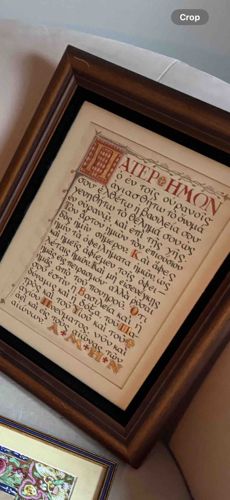
Framed Byzantine/Orthodox Calligraphy of The Lord's Prayer (Pater Noster)

Submitted photo of Framed Byzantine/Orthodox Calligraphy of The Lord's Prayer (Pater Noster)
Photo submitted by the user — not generated by AI

AI Estimated Value

Not an official valuation

$100-200

AI estimate as of October 3, 2025 · verify with a professional before acting

AI-Generated · Verify before acting

Everything on this page is generated by AI for informational purposes only. AI can make mistakes — the AI may misidentify items or misattribute them (artist, maker, brand, designer, origin, era). This is not an official valuation and should not be used for insurance, sale, tax, estate, legal, or lending purposes — or any decision requiring a certified appraisal. It is not an authoritative claim about any person, brand, or rights holder — do not share or rely on it as a factual statement about a third party. Always consult qualified professionals before making financial decisions.

Read the full disclaimer

AI Item Analysis

This item is a framed piece of calligraphy, likely a reproduction or a modern artistic rendering, featuring 'The Lord's Prayer' (Pater Noster) in Greek. The text is visibly in ancient or Koine Greek script, beginning with 'Πάτερ ἡμῶν' (Our Father), which is partially obscured by decorative initial 'Π' rather than 'ΑΤΕΡ ΗΜΟΝ' as suggested by the OCR. The calligraphy is executed in a traditional Byzantine or Orthodox style, characterized by its elaborate ornamentation and specific letterforms. The primary colors used in the text are black for the main body and red for initial letters of significant sections and some smaller decorative elements, emphasizing certain words or phrases. The initial 'Π' for 'Πάτερ' features intricate geometric patterns and interweaving lines in reds, oranges, and possibly gold or yellow hues, indicating a high level of decorative detail. Another large initial 'Κ' for 'Καί' is also highlighted in red. The paper or parchment on which the text is rendered appears to be subtly aged or cream-colored, adding to its antique aesthetic. The entire piece is presented within a dark brown wooden frame, possibly stained or lacquered, with a simple yet elegant profile. The frame includes an inner black border or matting, which provides a stark contrast to the light-toned calligraphy and enhances its visual impact. The visible condition suggests good preservation, with no apparent tears, creases, or significant discoloration beyond the intended aged look of the paper. There are no discernible maker's marks or signatures visible in the provided image. The style and execution suggest a reverence for traditional religious manuscripts, possibly a contemporary creation intended to evoke the look and feel of historical liturgical texts. The craftsmanship appears to be of good quality, focusing on legibility and aesthetic beauty, typical of devotional art or decorative religious pieces.
AI Appraisal Report

Based on my visual examination of the provided image, this framed calligraphy of 'The Lord's Prayer' in Greek presents as a well-executed modern decorative piece. The condition appears excellent, with no visible damage to the calligraphy or frame; the aged look of the paper is intentional. Authenticity as an antique or historical manuscript is highly improbable. The crispness of the lines, consistent aging effect, and lack of typical historical wear suggest it is a contemporary creation replicating traditional styles. While skillfully rendered, this is best described as devotional art or a decorative religious item intended to evoke historical liturgical texts. Market conditions for such contemporary religious art reproductions are generally moderate. Comparables would include framed prints or hand-rendered calligraphic pieces of similar size and decorative quality, often sold in religious gift shops or online art marketplaces. Demand is stable among individuals seeking aesthetically pleasing religious decor or gifts. Rarity is low as similar items are readily available. Key factors impacting value are its decorative appeal, lack of historical significance, and it not being a unique, hand-crafted artwork from a recognized calligrapher, which would command a higher price point. It is crucial to note the significant limitations of authenticity verification from images alone. Without physical inspection, I cannot confirm the exact medium (print vs. hand-drawn), the age of the paper, or the exact process of its creation. A full authentication would require in-person examination to assess the ink, paper, and execution details. Provenance documentation, such as artist's statements or purchase receipts, would also be invaluable. Scientific testing (e.g., carbon dating for the paper, ink analysis) would be necessary to definitively rule out any possibility of it being an older, albeit well-preserved, item, though this is highly unlikely given its appearance.

Keep exploring

More religious art/calligraphy appraisals

Get your items appraised

Instant AI-powered appraisal estimates from a photo

Browse More Appraisals