AI identification & appraisal estimate

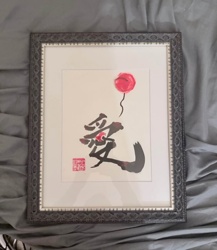
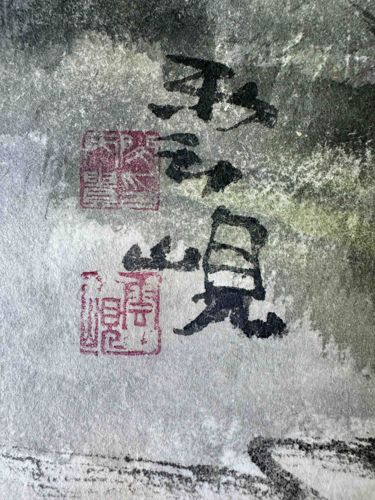
East Asian Ink and Wash Calligraphy with Red Seals

Submitted photo of East Asian Ink and Wash Calligraphy with Red Seals
Photo submitted by the user — not generated by AI

User's notes

Calligraphy hand painted

These notes were written by the person who submitted this item. Appraiser.AI has not verified them, and the AI's identification and estimate may rely on them.

AI Estimated Value

Not an official valuation

$300-500

AI estimate as of September 23, 2025 · verify with a professional before acting

AI-Generated · Verify before acting

Everything on this page is generated by AI for informational purposes only. AI can make mistakes — the AI may misidentify items or misattribute them (artist, maker, brand, designer, origin, era). This is not an official valuation and should not be used for insurance, sale, tax, estate, legal, or lending purposes — or any decision requiring a certified appraisal. It is not an authoritative claim about any person, brand, or rights holder — do not share or rely on it as a factual statement about a third party. Always consult qualified professionals before making financial decisions.

This analysis also relies on unverified notes provided by the user, which may be incomplete or inaccurate and could affect the result.

Read the full disclaimer

AI Item Analysis

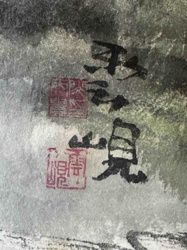
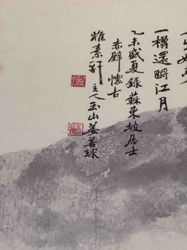
This item is a fragment or detail of a piece of East Asian calligraphy, executed in traditional ink and wash on what appears to be paper or a similar fibrous material. The dominant colors are black for the calligraphic characters and two shades of red for the seals, set against a background that transitions from a light, mottled grey-white to darker, more textured grey and subtly green-tinged areas. The surface exhibits a somewhat coarse and absorbent texture, typical of rice paper or similar art papers used for ink painting and calligraphy, which allows the ink to softly bleed and create subtle tonal variations. The brushwork for the characters is fluid and expressive, showcasing varying line thickness and pressure, indicative of skilled hand-painting. There are three prominent black characters visible, with the top character appearing particularly bold and the lower two slightly lighter. Below these characters is a red square seal, displaying intricately carved characters in a traditional style. A second, smaller rectangular red seal is positioned further down and to the left of another black character. The condition of the piece appears stable, though there are subtle variations in the background tone that might indicate age-related discoloration or perhaps intentional washes by the artist to create atmosphere. No obvious tears, creases, or repairs are visible in this cropped section, but the overall mottled appearance of the background could suggest some general wear or accumulation of patina over time. The craftsmanship is high, demonstrating control over the ink and brush, which is characteristic of the quality associated with traditional East Asian fine art. The presence of multiple seals suggests a signature or authentication process, common in classical and modern works from the region. The style period is difficult to ascertain from this detail alone, but it aligns with various forms of traditional calligraphic expression that have been practiced for centuries.
AI Appraisal Report

I have examined the provided image of this East Asian Ink and Wash Calligraphy with Red Seals. Based on the visual evidence, the condition appears stable. The subtle variations in the background tone suggest age-related discoloration consistent with traditional paper, rather than significant damage. The craftsmanship is evident in the fluid and expressive brushwork, indicating a skilled hand. The presence of two red seals is typical for authenticating and signing East Asian calligraphy. However, authenticity cannot be definitively confirmed from images alone. Market conditions for East Asian calligraphy vary widely based on the artist's renown, age of the piece, and historical significance. Without knowing the artist or the period, it is difficult to precisely gauge demand. This fragment, while aesthetically pleasing, lacks the overall composition of a complete work, which generally limits its marketability. Comparable unsigned or unattributed fragments of traditional calligraphy typically fetch modest prices. The intrinsic artistic merit is apparent, but the absence of a known artist or complete provenance affects rarity and, consequently, value. Factors significantly impacting value here are the unknown artist, the incomplete nature of the piece (being a fragment), and the lack of verifiable provenance. For full authentication, an in-person examination would be critical to assess the paper's aging, ink characteristics, and seal impressions in detail. Furthermore, research into the seals and characters for attribution would be necessary. Provenance documentation, such as exhibition histories or prior ownership records, would greatly enhance its value and confirm authenticity.

Keep exploring

More fine art - calligraphy appraisals

Get your items appraised

Instant AI-powered appraisal estimates from a photo

Browse More Appraisals