AI estimate as of July 5, 2025 · verify with a professional before acting
AI-Generated · Verify before acting
Everything on this page is generated by AI for informational purposes only. AI can make mistakes — the AI may misidentify items or misattribute them (artist, maker, brand, designer, origin, era). This is not an official valuation and should not be used for insurance, sale, tax, estate, legal, or lending purposes — or any decision requiring a certified appraisal. It is not an authoritative claim about any person, brand, or rights holder — do not share or rely on it as a factual statement about a third party. Always consult qualified professionals before making financial decisions.
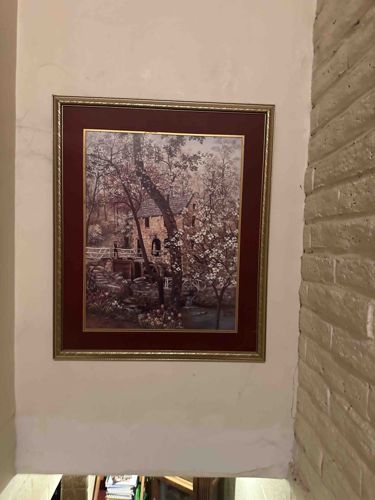
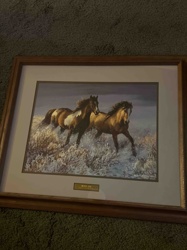
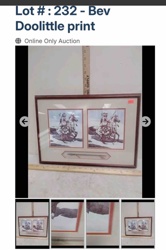
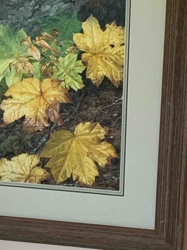
The item is a framed art print depicting a picturesque landscape scene, most likely a watermill or an old house nestled amidst trees. The dominant colors in the print appear to be earthy tones, greens, and browns, with notable white or light pink blossoms on some of the trees, suggesting a spring or early summer setting. A body of water, possibly a pond or stream, is visible in the foreground or midground, reflecting the surrounding scenery. The print is housed within a multi-layered frame. The innermost layer is a narrow, light-colored (possibly gold or brass-toned) fillet directly bordering the print. This is followed by a wider mat board in a rich maroon or burgundy color, which provides a strong contrast and draws attention to the artwork. The outermost frame is a traditional, ornate-style, gold-toned frame with some visible detailing along its edges, suggesting a classic or traditional aesthetic. The frame shows some signs of wear consistent with age and handling, such as minor scuffs or dulling of the finish, but no significant damage like cracks or breaks are discernible. The print itself appears to be in good condition, with no visible fading, tears, or creasing. Given the general style of the artwork and the framing choice, the piece likely dates from the late 20th century to early 21st century, possibly a commercially produced decorative print. There are no discernible artist signatures or manufacturing marks visible in the provided image. The overall craftsmanship of the framing appears to be of standard quality for mass-produced framed art.
AI Appraisal Report
Upon visual examination of the provided image, I assess this framed landscape print to be in good overall condition. The print itself shows no visible signs of fading, tears, or creasing, maintaining its original vibrancy. The multi-layered frame, consisting of a narrow light-colored fillet, a wide maroon mat, and a traditional gold-toned outer frame, appears structurally sound. There are minor scuffs or dulling on the outer frame, consistent with age and handling, but no damage significant enough to detract from its decorative appeal.
This piece appears to be a commercially produced decorative print, likely dating from the late 20th to early 21st century. The absence of a visible artist's signature or manufacturing marks, combined with the general aesthetic and framing style, suggests it is not a fine art original or a limited-edition print by a recognized artist. This significantly impacts its market value.
The market for such decorative framed prints is generally robust but characterized by high supply and moderate demand. Comparables in the secondary market, such as online marketplaces or consignment shops, suggest that similar mass-produced framed landscapes typically retail in the lower price tiers. Rarity is not a factor here; items of this type are widely available.
Factors significantly impacting value are its decorative nature, commercial origin, and the lack of artist attribution or provenance. While visually appealing, it does not possess investment-grade qualities.
Limitations: Authenticity verification from images alone is inherently limited. A full authentication would require in-person examination to assess print quality (e.g., dot pattern indicating printing method), identify any hidden marks or labels on the reverse of the print or frame, and, if a signature were present, compare it to known examples. Provenance documentation could establish a chain of ownership, though it's unlikely for a piece of this type to have extensive records. Scientific testing (e.g., pigment analysis) would be unnecessary and disproportionate to the item's likely value.