Inward curved, smaller knife with bone handle in hard leather sheath
These notes were written by the person who submitted this item. Appraiser.AI has not verified them, and the AI's identification and estimate may rely on them.
AI Estimated Value
Not an official valuation
$40-70
AI estimate as of December 16, 2025 · verify with a professional before acting
AI-Generated · Verify before acting
Everything on this page is generated by AI for informational purposes only. AI can make mistakes — the AI may misidentify items or misattribute them (artist, maker, brand, designer, origin, era). This is not an official valuation and should not be used for insurance, sale, tax, estate, legal, or lending purposes — or any decision requiring a certified appraisal. It is not an authoritative claim about any person, brand, or rights holder — do not share or rely on it as a factual statement about a third party. Always consult qualified professionals before making financial decisions.
This analysis also relies on unverified notes provided by the user, which may be incomplete or inaccurate and could affect the result.
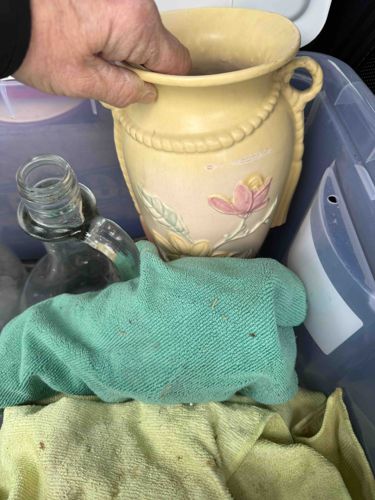
This item is a vintage pottery vase, characterized by its pale yellow or cream-colored glazed ceramic construction. The vase features a classic urn-like shape with a slightly flared rim and a sturdy, presumably footed base, though the base is not fully visible. Notable decorative elements include two small, C-shaped handles positioned just below the rim, adorned with a raised rope-like motif that extends horizontally across the body of the vase, creating a band around its upper portion. Below this rope band, the main body of the vase is decorated with a vibrant floral relief design. A prominent pink flower with multiple petals and green leaves is centrally located, appearing hand-painted or hand-applied, suggesting a level of craftsmanship. The surface of the vase exhibits some visible condition issues: there are several dark spots or specks, possibly dirt or minor staining, and what appears to be some scuffing or slight imperfections in the glaze, particularly on the main body of the vase and around the rim. The overall aesthetic suggests a mid-20th century style, possibly Art Deco or early Mid-Century Modern, given the color palette and decorative techniques. There are no discernible maker's marks or signatures visible in the provided image. The quality of the relief work appears good, with defined lines and colors, indicative of a mass-produced item from a reputable pottery manufacturer of the era.
AI Appraisal Report
Based on my visual examination of the provided image, this vintage pottery vase, characterized by its pale yellow/cream glaze, floral relief, and rope motif, appears to be a mass-produced decorative item likely from the mid-20th century. The urn-like shape and decorative elements are consistent with styles prevalent during the Art Deco to early Mid-Century Modern periods. While the floral relief and rope motif are well-executed, indicating a reputable manufacturer, the absence of any visible maker's marks or signatures limits immediate identification and authentication.
The condition, as observed, presents several dark specks, possibly dirt or minor staining, and scuffing, particularly on the main body and rim. These imperfections, while not severe, affect the overall aesthetic and value. The authenticity as a genuine vintage piece from the mid-20th century appears visually plausible, given the style and perceived manufacturing techniques of the era.
Market conditions for such decorative pottery often depend heavily on brand recognition and rarity. Without a discernible maker, this piece falls into a broad category of attractive, yet relatively common, vintage decorative ceramics. Comparable items from unidentified manufacturers typically fetch modest prices in vintage markets, antique shops, and online platforms. The demand for general vintage decorative pottery is stable but not exceptionally high unless associated with a well-known name or an exceptionally unique design.
Factors significantly impacting value here are the lack of a maker's mark, the slight condition issues, and the general availability of similar pieces. While visually appealing, its market standing is primarily as a decorative home accent rather than a collector's investment piece.
It is crucial to note the limitations in authentication from images alone. A physical inspection would be necessary to (1) thoroughly assess surface imperfections, cracks, or repairs not visible; (2) search for any hidden or faint maker's marks on the base; and (3) conduct tactile examination of the glazes and clay body, which can sometimes provide clues to origin and age. Provenance documentation, if available, would further assist in verifying its history.