AI estimate as of September 21, 2025 · verify with a professional before acting
AI-Generated · Verify before acting
Everything on this page is generated by AI for informational purposes only. AI can make mistakes — the AI may misidentify items or misattribute them (artist, maker, brand, designer, origin, era). This is not an official valuation and should not be used for insurance, sale, tax, estate, legal, or lending purposes — or any decision requiring a certified appraisal. It is not an authoritative claim about any person, brand, or rights holder — do not share or rely on it as a factual statement about a third party. Always consult qualified professionals before making financial decisions.
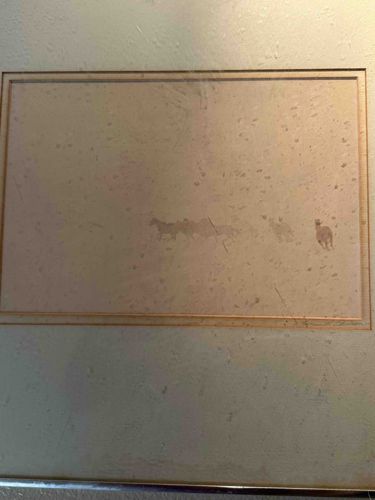
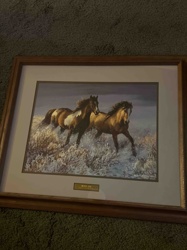
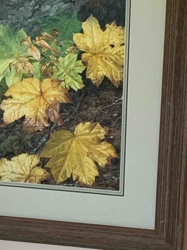
The item appears to be a framed print or artwork, predominantly rectangular in shape and oriented horizontally. The main subject matter, though heavily faded, seems to depict a pastoral scene with silhouettes of animals, specifically what looks like a horse in motion and a more static bovine figure (possibly lamb or calf) on the right side. The overall color palette is muted, with the central image area appearing as a light brown or beige, showing significant discoloration, spots, and streaks, which may be foxing, mold, or environmental residue. This suggests substantial degradation over time, likely due to exposure to moisture, light, or general aging. The print is enclosed within what appears to be a double matting system. The inner border immediately surrounding the image is a thin, light-colored line, possibly gold or a contrasting neutral tone, which helps define the artwork area. Surrounding this is a wider mat, extending to the frame. This mat also shows signs of aging and discoloration, with its original color likely being a light neutral tone. The outermost component is a narrow, light-colored frame, possibly wood with a thin gold or natural finish, though its precise material is difficult to ascertain from the image alone. The style suggests a post-impressionist or early 20th-century aesthetic, perhaps a landscape print or reproduction. The significant fading and spotting are major condition issues that would considerably impact its aesthetic and monetary value. No clear artist's signature, title, or manufacturer's marks are visible. The craftsmanship appears to be standard for framed prints of its likely era, but the condition issues overshadow any inherent quality indicators.
AI Appraisal Report
Upon examining the provided image of the 'Framed Faded Print with Equine and Bovine Silhouettes,' I assess its condition as poor. The print exhibits severe degradation, including significant fading, extensive discoloration, prominent spotting, and streaking, likely indicative of foxing, mold, or environmental damage from moisture and light exposure. These issues profoundly compromise its aesthetic appeal and structural integrity. The precise authenticity of the print and its age are difficult to ascertain from images alone; it appears to be a reproduction rather than an original work of art. Without an visible artist's signature, title, or manufacturer's marks, its provenance is entirely unknown.
Market conditions for such heavily degraded, unsigned, and unattributed prints are extremely low. Comparables would include decorative, mass-produced prints found in flea markets or thrift stores, particularly those in similar poor condition. There is very limited demand for items with such extensive condition issues, and rarity is not a factor given the likely reproductive nature and lack of artistic attribution. The significant fading, discoloration, and overall poor condition are the primary factors severely impacting its value.
Limitations in authenticity verification are substantial. A definitive assessment would require in-person examination to inspect the paper, print technique (e.g., lithograph, photolithograph), and frame construction more closely. Provenance documentation, including information on its artist, publisher, and exhibition history, would be essential for establishing any artistic or historical significance. Scientific testing, such as pigment analysis or paper dating, could provide further insights into its age and composition, though such extensive testing would likely exceed the item's potential monetary value.