These notes were written by the person who submitted this item. Appraiser.AI has not verified them, and the AI's identification and estimate may rely on them.
AI Estimated Value
Not an official valuation
$75 - $150
AI estimate as of November 11, 2025 · verify with a professional before acting
AI-Generated · Verify before acting
Everything on this page is generated by AI for informational purposes only. AI can make mistakes — the AI may misidentify items or misattribute them (artist, maker, brand, designer, origin, era). This is not an official valuation and should not be used for insurance, sale, tax, estate, legal, or lending purposes — or any decision requiring a certified appraisal. It is not an authoritative claim about any person, brand, or rights holder — do not share or rely on it as a factual statement about a third party. Always consult qualified professionals before making financial decisions.
This analysis also relies on unverified notes provided by the user, which may be incomplete or inaccurate and could affect the result.
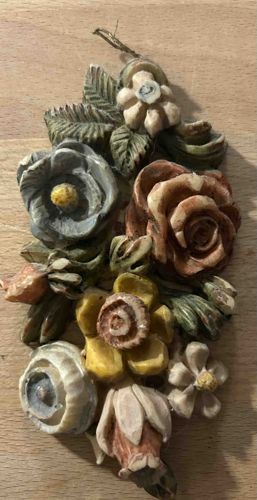
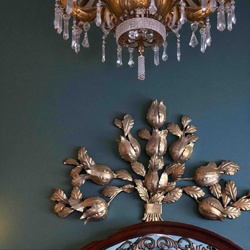
This item is a decorative wall hanging that appears to be crafted from natural elements, primarily snail shells, arranged to form a mixed floral bouquet. The overall size is difficult to ascertain from the image alone, but it seems to be a medium-sized piece, likely intended for accent decor. The construction shows various types and sizes of shells, carefully assembled to represent different flowers and botanical elements. Some shells are arranged to form rose-like shapes with swirling petals in shades of earthy brown and light beige. Others are smaller, representing individual blossoms with a central stamen-like protrusion, colored in muted tones of gray, cream, and pale yellow. Several shells are used to create what appears to be foliage or leaves, exhibiting a greenish-brown hue and textured surfaces, suggesting a natural origin. One prominent shell, possibly a larger snail shell, is featured on the lower left, presenting a distinct spiral pattern and a blueish-gray interior opening. Another shell, centrally located, is arranged with its spiral facing outwards, giving it a unique floral center. The colors are predominantly natural and earthy, ranging from light creams and yellows to deeper browns, greens, and grays, with some reddish-brown accents. The craftsmanship suggests a folk art or artisanal approach, emphasizing the natural beauty and irregular textures of the shells. There are no obvious signs of significant damage or repairs, but the aged appearance of the shells and string hanging loop (visible at the top) suggests a vintage or antique quality. The item's condition appears consistent with its age, showing a natural patina. No manufacturer's marks or signatures are visible in the provided image. The style leans towards classical or rustic floral arrangements, likely from the mid-20th century or earlier.
AI Appraisal Report
Based on my visual examination of the provided image, this Mixed Floral Snail Shell Wall Decor appears to be an intriguing piece of folk art. The arrangement of natural snail shells to form a floral bouquet is characteristic of artisanal craftsmanship, likely from the mid-20th century. The natural, earthy color palette and the textured surfaces contribute to its rustic appeal.
The condition appears consistent with an item of its age, showing a natural patina on the shells. There are no obvious signs of significant damage or repairs from the image, but a hands-on inspection would be necessary to confirm structural integrity, identify any hidden repairs, or assess the stability of the shell attachments. The string hanging loop suggests a utilitarian or handmade origin, further supporting its folk art classification.
Authenticity, in terms of its construction from genuine shells and its vintage age, seems plausible. However, without a physical examination, I cannot definitively verify the exact age, the types of adhesive used (if any), or rule out modern reproductions attempting to mimic vintage styles. More importantly, the owner's mention of an "Antique cake knife" is confusing and irrelevant to this wall decor, suggesting a potential miscommunication or error in the item's description during submission. This discrepancy highlights the limitations of image-based appraisal.
Market conditions for natural material folk art can vary. While unique, the demand for shell-based decor tends to be niche. Comparable items of this nature, especially without a known artist or significant provenance, generally fall into the decorative arts category rather than fine art. Rarity is difficult to ascertain; while each piece is unique, similar shell craft items are not exceedingly rare. Factors impacting value include the quality of assembly, the variety and condition of the shells, and overall aesthetic appeal. Without provenance documentation or in-person examination, verifying a specific maker or origin is impossible.
Considering these factors, I would place the appraisal value between $75 and $150. A more precise valuation would require a physical inspection to assess the craftsmanship, materials, and overall condition thoroughly.