AI estimate as of November 12, 2025 · verify with a professional before acting
AI-Generated · Verify before acting
Everything on this page is generated by AI for informational purposes only. AI can make mistakes — the AI may misidentify items or misattribute them (artist, maker, brand, designer, origin, era). This is not an official valuation and should not be used for insurance, sale, tax, estate, legal, or lending purposes — or any decision requiring a certified appraisal. It is not an authoritative claim about any person, brand, or rights holder — do not share or rely on it as a factual statement about a third party. Always consult qualified professionals before making financial decisions.
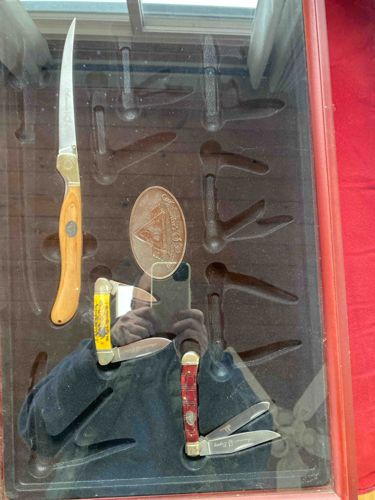
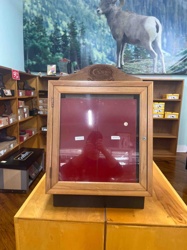
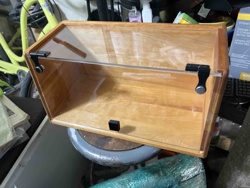
This item is a display case, likely fashioned from wood with a visible red trim on the right side, housing several collectible knives and a coin. The case features a clear, transparent lid, possibly glass or acrylic, which serves to protect the contents while allowing them to be viewed. The interior of the case is fitted with a molded insert, providing dedicated slots or depressions to securely hold each item in place. This insert appears to be made of a dark-colored, possibly felt-lined or vacuum-formed plastic, configured to accommodate the specific shapes of the knives and coin.
Among the visible items, there is a relatively long, slender knife with a curved blade and a light-colored wooden handle, accented with brass-toned bolsters and a circular emblem or medallion embedded in the handle. This knife appears to be a fillet or boning knife due to its blade shape. Another knife is a folding pocket knife with a yellow handle, exhibiting a more traditional pocket knife design with at least two blades visible. A third folding pocket knife, positioned towards the bottom right, features a reddish, possibly jigged bone or synthetic handle, also with brass bolsters and two blades extended. One of the extended blades shows a faint inscription, suggesting a brand name or model number, though it is not clearly legible.
In the center of the display, there is a circular, metallic coin or medallion, seemingly made of copper or bronze, with an embossed design on its face. The design on the coin is difficult to discern definitively but appears to include geometric shapes or symbols. The overall condition of the items inside the case appears good, suggesting they have been preserved for display. The case itself shows some reflections on the clear cover, indicative of the lighting conditions during photography, but no readily apparent damage to the case or its contents is visible.
AI Appraisal Report
Upon visual examination of the provided image, I have assessed this Knives and Coin Display Case. The overall condition of the display case and its contents appears good, suggesting preservation for display. The visible knives include a slender fillet-style knife, a yellow-handled folding knife, and a red-handled folding knife. The coin in the center is metallic, likely copper or bronze. My assessment of authenticity is limited to visual cues; without physical inspection, I cannot verify the authenticity of the knives as genuine collectibles or the coin as a valuable numismatic item. The red trim on the case and the molded interior suggest a commercially produced display rather than a custom high-end piece.
Market conditions for such display cases with mixed, non-premium collectible knives and a generic coin are generally modest. Comparable items featuring mass-produced knives and common coins typically sell in the low to mid-range. The demand for such a specific grouping of items is not exceptionally high, nor are the items individually rare based on their appearance.
Factors significantly impacting value include the lack of identifiable premium brands for the knives, the absence of clear detail or rarity for the coin, and the functional rather than artistic nature of the display case itself. To fully authenticate the items and provide a precise valuation, an in-person examination would be crucial. This would involve identifying the specific manufacturers and models of the knives, assessing their materials (e.g., blade steel, handle materials), and determining the origin, metal content, and rarity of the coin. Provenance documentation (receipts, certificates of authenticity) would greatly assist in verifying the authenticity and potential value of the individual components. Without this, the valuation remains an estimate based on general market trends for similar, readily available display sets.