AI estimate as of July 10, 2025 · verify with a professional before acting
AI-Generated · Verify before acting
Everything on this page is generated by AI for informational purposes only. AI can make mistakes — the AI may misidentify items or misattribute them (artist, maker, brand, designer, origin, era). This is not an official valuation and should not be used for insurance, sale, tax, estate, legal, or lending purposes — or any decision requiring a certified appraisal. It is not an authoritative claim about any person, brand, or rights holder — do not share or rely on it as a factual statement about a third party. Always consult qualified professionals before making financial decisions.
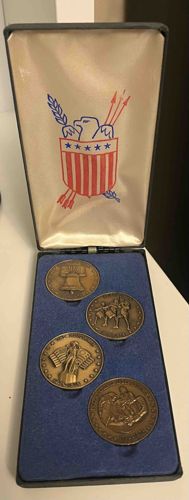
This item is a boxed set of four commemorative medals, likely made of bronze or a bronze-toned metal alloy, presented within a dark blue velvet-lined display case. The medals each feature distinct designs, suggesting they commemorate different significant aspects of American history or heritage. One medal clearly depicts the Liberty Bell, another shows three figures, possibly fife and drum corps, indicative of colonial or Revolutionary War themes. A third medal features a winged figure, possibly symbolizing liberty or victory. The fourth medal, partially obscured, appears to have an eagle with an olive branch and arrows, a common American heraldic motif. The medals exhibit a consistent size and circular shape, with raised relief detailing on their obverses. Their surfaces show a uniform, antiqued patina, suggesting either age or an intentional finish to give them an aged appearance. There are no obvious signs of significant wear or surface damage, indicating they have been well-preserved within their case. The case itself is rectangular, with a hinged lid. The exterior appears to be a dark, possibly black or dark gray, material, while the interior of the lid is lined with a creamy, possibly satin or silk, fabric. Printed on the interior lid fabric is a stylized patriotic emblem, featuring an eagle head emerging from a shield with stars and red and white stripes, flanked by what appear to be an olive branch and arrows. This emblem reinforces the American historical theme of the medals. The overall craftsmanship suggests a mass-produced, yet thoughtfully designed, commemorative set. Based on the themes and style, the set likely dates from the mid-20th century, possibly around the American Bicentennial in 1976 or an earlier significant historical anniversary.
AI Appraisal Report
I have examined the provided image of this Set of Four Commemorative American History Medals in a Display Case. Based on the visual evidence, the medals appear to be in excellent condition, exhibiting a consistent antiqued patina and no visible signs of significant wear or surface damage. The velvet-lined display case also appears well-preserved, with the interior lid art intact. The design aesthetics, particularly the patriotic emblem inside the lid, strongly suggest a mid-20th century origin, likely around the 1976 American Bicentennial, a period when such commemorative sets were very popular.
From a market perspective, these types of commemorative medal sets are generally part of a mass-produced collectible market. While appealing for their historical themes and decorative nature, they typically do not contain precious metals and were issued in large quantities. Comparable items, often found on online auction sites or at antique malls, usually retail in the range of $20 to $50. Demand for these specific sets is modest, driven primarily by collectors of Americana, historical memorabilia, or those seeking decorative display pieces. Rarity is not a significant factor here; these were widely distributed.
The primary factor impacting value is their decorative appeal and collectible interest rather than intrinsic material value or rarity. Without physical inspection, I cannot confirm the exact metal composition (e.g., bronze, copper alloy, or base metal with bronze finish) or the method of manufacture (e.g., struck or cast). An in-person examination would allow for clearer assessment of weight, detailed surface texture, and confirmation of material through potential acid testing or spectroscopic analysis if necessary. Furthermore, provenance documentation, such as original sales receipts or certificates of authenticity, would provide context but are rarely available for such items and do not significantly alter their market value.
In summary, while well-preserved and visually appealing, this set belongs to a class of common commemorative collectibles. Its value is more decorative and nostalgic than monetary.