AI estimate as of August 9, 2025 · verify with a professional before acting
AI-Generated · Verify before acting
Everything on this page is generated by AI for informational purposes only. AI can make mistakes — the AI may misidentify items or misattribute them (artist, maker, brand, designer, origin, era). This is not an official valuation and should not be used for insurance, sale, tax, estate, legal, or lending purposes — or any decision requiring a certified appraisal. It is not an authoritative claim about any person, brand, or rights holder — do not share or rely on it as a factual statement about a third party. Always consult qualified professionals before making financial decisions.
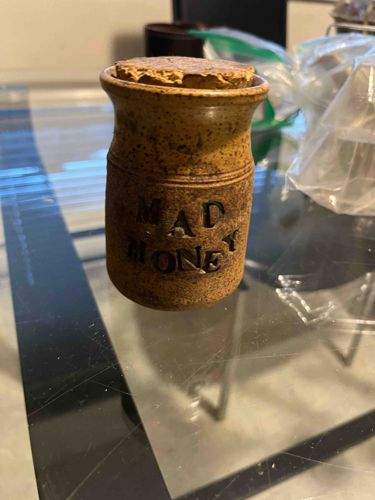
This item is a small, cylindrical stoneware crock or jar, likely used as a whimsical money bank or container, titled 'MAD MONEY'. It features a distinctive speckled, earthy brown glaze with visible dark speckles throughout, suggesting a salt-glazed or similar rustic pottery technique. The overall form is a classic jar shape, widening slightly towards the top before tapering to a rim designed to hold a cork stopper. The stopper itself is made of natural cork, showing a coarse, uneven texture and a light brown color consistent with aged cork. The words 'MAD MONEY' are deeply impressed into the front surface of the jar in a bold, capitalized, sans-serif font, giving it a somewhat playful yet permanent quality. The letters appear to have a darker wash or patina in their recesses, enhancing their visibility against the lighter stoneware. There are two horizontal incised lines banding the jar above and below the "MAD MONEY" inscription, adding a decorative and structural element to its design. The surface exhibits a typical matte to semi-gloss finish characteristic of stoneware, and there are visible signs of age and use, including potential surface grime or a natural patina that darkens some areas. No apparent cracks or major chips are visible, suggesting good structural integrity, but common wear such as minor abrasions or scuffs consistent with handling over time would be expected. The craftsmanship appears to be sturdy and utilitarian, yet with an artistic flair due to the glazing and impressed text. Given its aesthetic and common pottery styles, it likely dates from the mid-20th century onwards.
AI Appraisal Report
Upon my virtual examination of this stoneware 'MAD MONEY' jar, I find it to be in good overall condition. The speckled, earthy brown glaze with visible dark speckles is consistent with mid-20th century rustic pottery, likely salt-glazed. The impressed 'MAD MONEY' text and incised banding are clear and well-executed, contributing to its decorative appeal. I observe no apparent cracks or major chips from the images provided, indicating good structural integrity. However, without a physical inspection, I cannot confirm the absence of minor abrasions, scuffs, or surface grime consistent with age and use. The cork stopper appears original and shows appropriate wear.
The demand for quirky vintage home decor, particularly stoneware items with folk art appeal, is steady. While not exceedingly rare, pieces like this 'MAD MONEY' jar fall into a desirable niche for collectors of countryware, primitive decor, or unique banks. Comparables frequently appear on online marketplaces and at antique shows, typically ranging from $20 to $60 depending on condition, design, and provenance. This specific jar's clear lettering and good condition enhance its marketability.
Factors impacting value include its functional and decorative appeal, the rustic aesthetic, and its relatively good preservation. The main limitation in my authentication is the reliance solely on visual examination. An in-person inspection would allow me to assess the surface texture more accurately for any hidden imperfections, determine the precise weight, and verify the quality of the stoneware more definitively. Provenance documentation, though unlikely for an item of this nature and value, would confirm its history. Scientific testing, such as thermoluminescence dating, would be excessive for an item in this price range but would provide definitive age verification.