AI estimate as of July 5, 2025 · verify with a professional before acting
AI-Generated · Verify before acting
Everything on this page is generated by AI for informational purposes only. AI can make mistakes — the AI may misidentify items or misattribute them (artist, maker, brand, designer, origin, era). This is not an official valuation and should not be used for insurance, sale, tax, estate, legal, or lending purposes — or any decision requiring a certified appraisal. It is not an authoritative claim about any person, brand, or rights holder — do not share or rely on it as a factual statement about a third party. Always consult qualified professionals before making financial decisions.
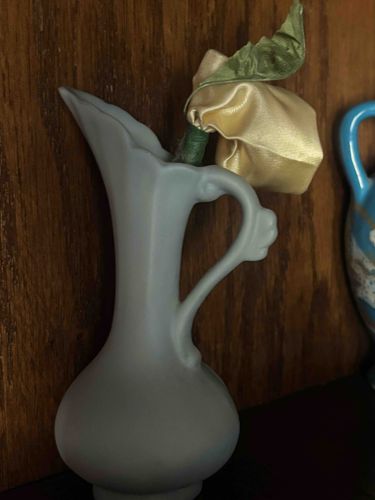
The item is a small, light grey or pale blue ceramic pitcher or creamer, characterized by a smooth, matte finish that suggests milk glass or bisque porcelain. The total visible height is approximately 6-8 inches, with a rounded, bulbous body tapering upwards to a narrow neck and then flaring out into a defined pouring spout. The handle is gracefully curved, extending from just below the rim to the upper portion of the body, and features a subtle decorative element, possibly a scroll or leaf-like detail, near the top attachment point. The color appears to be uniform throughout, without any visible patterns or painted decorations on its surface. There are no obvious chips, cracks, or repairs visible in the provided image, indicating a relatively good state of preservation. The matte surface, however, could be susceptible to smudges or dirt pickup, though none are prominently displayed. The craftsmanship appears to be reasonably good, with a well-formed handle and spout, showing a decent level of detail for a decorative object. Inside the pitcher, there's a faux flower, seemingly made of light yellow or cream-colored satin fabric, with a green fabric leaf, typical of artificial floral arrangements. The presence of this artificial flower suggests the pitcher is intended more as a decorative accent rather than a functional piece for liquids. The style of the pitcher, with its classic form and unadorned matte finish, could suggest a mid-20th century to contemporary manufacturing period, aligning with various decor trends favoring simple, elegant lines. There are no visible maker's marks or signatures in the provided view.
AI Appraisal Report
Upon visual examination of the provided image, I assess this matte grey ceramic pitcher as being in remarkably good condition. There are no visible chips, cracks, or repairs, which is excellent for a ceramic piece. The matte finish appears well-preserved, though as noted, this type of surface is prone to smudges or dirt pickup, which are not apparent here. The inclusion of the faux flower suggests its primary function as a decorative accent rather than a utilitarian object. Authenticity, based solely on an image, is limited; I can confirm it appears to be a genuine ceramic object, but determining its age more precisely than "mid-20th century to contemporary" or specific manufacturer without handling it or seeing maker's marks is impossible.
Market conditions for decorative ceramic pitchers of this style are stable but generally not high-value. This item falls squarely into the general home decor category. Comparables would include similar matte ceramic or bisque porcelain decorative pitchers found in secondary markets, antique malls, or contemporary home goods stores. Demand for such pieces is consistent, driven by current tastes for minimalist and neutral home aesthetics. However, the item lacks rarity; it doesn't present as an antique from a renowned maker, nor does it possess unique artistic properties that would elevate its value significantly. Factors impacting value are primarily its excellent condition and aesthetic appeal, but the lack of provenance, maker's marks, and its common decorative nature keeps the value modest.
For full authentication, a physical in-person examination would be required to look for maker’s marks, assess the ceramic body's specific characteristics (e.g., weight, texture, firing quality), and potentially identify the type of clay or glaze used. Provenance documentation would be crucial to trace its history and confirm any potential origins from a specific designer or studio, which could significantly impact its value if it were part of a recognized collection or production line. Without these, the appraisal remains based on its decorative merit and condition as a generic home decor item.