AI estimate as of December 6, 2025 · verify with a professional before acting
AI-Generated · Verify before acting
Everything on this page is generated by AI for informational purposes only. AI can make mistakes — the AI may misidentify items or misattribute them (artist, maker, brand, designer, origin, era). This is not an official valuation and should not be used for insurance, sale, tax, estate, legal, or lending purposes — or any decision requiring a certified appraisal. It is not an authoritative claim about any person, brand, or rights holder — do not share or rely on it as a factual statement about a third party. Always consult qualified professionals before making financial decisions.
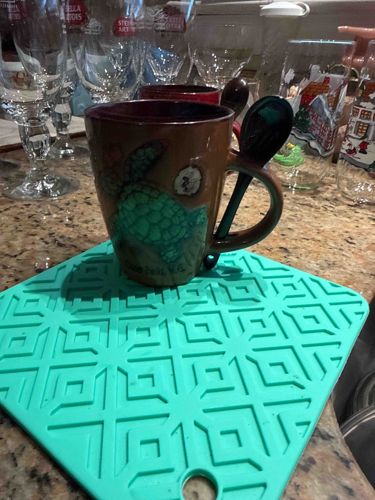
This item is a ceramic mug featuring a prominent sea turtle design, accompanied by a dark-colored spoon held within the mug's handle, and resting on a textured, square-shaped silicone trivet. The mug itself appears to be made of glazed ceramic with a rustic, earthy brown color on its exterior. The interior of the mug is dark, possibly a deep maroon or dark brown. The dominant decorative element is a large, stylized sea turtle in a teal or turquoise hue, depicted in a somewhat abstract, textured manner on the side of the mug. There might be some lighter accents or elements accompanying the turtle design, possibly a small circular 'bubble' or moon-like shape. The handle of the mug is also ceramic, matching the exterior color. Tucked into the handle is a long-handled spoon, likely made of plastic or melamine, with a dark, possibly black or very dark blue color. The spoon has a distinctive shape with a slightly elongated and possibly pointed end, suggesting it might be a stirring spoon for beverages. The mug displays no obvious signs of chips, cracks, or significant wear, maintaining its glossy finish. The silicone trivet, which the mug sits upon, is a vibrant teal or aqua color. It is square or nearly square with a raised, geometric pattern resembling interlocking squares and rectangles, creating a mosaic-like texture across its surface. One corner of the trivet shows a circular hole, likely for hanging. The trivet appears to be in excellent condition, showing no tears or discoloration. This ensemble suggests a casual, perhaps beach-themed or nature-inspired aesthetic. The craftsmanship of the mug seems to be of a standard commercial quality, with the hand-painted or decal application of the sea turtle design being a key visual feature. The item likely dates from recent decades, consistent with contemporary kitchenware aesthetics.
AI Appraisal Report
Upon visual examination of the provided image, I assess this 'Sea Turtle Design Ceramic Mug with Spoon and Silicone Trivet' to be in excellent condition. The ceramic mug shows no apparent chips, cracks, or significant wear to its glaze, and the sea turtle design appears intact. The accompanying dark spoon and the teal silicone trivet also seem free from damage or discoloration. The item's authenticity, as a mass-produced kitchenware set, is not typically a concern. This is a contemporary piece, likely manufactured in recent decades.
Market conditions for novelty or decorative mugs, particularly those with a nature or beach theme, are generally robust, but the supply is also very high. Comparable items, often found in retail stores, gift shops, or online marketplaces, typically retail in the $10-$30 range, depending on brand and specific design. While the sea turtle design is appealing, it's not unique enough to command a premium as a rare or collectible item. The inclusion of a matching spoon and trivet adds some perceived value as a 'set,' but these are also common components of such offerings.
Demand for such an item is primarily from individuals seeking functional kitchenware with a decorative touch, or as a casual gift. Its rarity is low; similar items are widely available. Factors impacting value are primarily its good condition and cohesive design. However, it lacks any artistic provenance, limited edition status, or high-quality material (e.g., fine porcelain, hand-carved spoon) that would significantly increase its worth.
Limitations regarding authenticity verification from images alone are minimal for this type of item. Physical examination would primarily confirm the absence of subtle hairline cracks, surface imperfections not visible in the photo, and the exact material composition of the spoon and trivet. Provenance documentation or scientific testing are not applicable or necessary for this category of contemporary kitchenware.