These notes were written by the person who submitted this item. Appraiser.AI has not verified them, and the AI's identification and estimate may rely on them.
AI Estimated Value
Not an official valuation
$350-550
AI estimate as of December 2, 2025 · verify with a professional before acting
AI-Generated · Verify before acting
Everything on this page is generated by AI for informational purposes only. AI can make mistakes — the AI may misidentify items or misattribute them (artist, maker, brand, designer, origin, era). This is not an official valuation and should not be used for insurance, sale, tax, estate, legal, or lending purposes — or any decision requiring a certified appraisal. It is not an authoritative claim about any person, brand, or rights holder — do not share or rely on it as a factual statement about a third party. Always consult qualified professionals before making financial decisions.
This analysis also relies on unverified notes provided by the user, which may be incomplete or inaccurate and could affect the result.
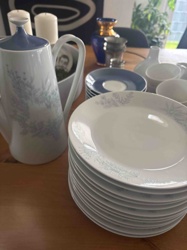
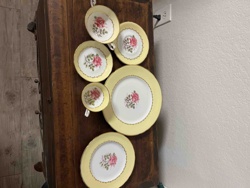
This is a comprehensive full set of decorative porcelain or china dinnerware. The collection appears to consist of numerous pieces including a large ornate teapot or coffee pot with an elaborate handle and lid, multiple stacks of plates (dinner, salad, and possibly bread plates), several bowls, a gravy boat, and a lidded sugar bowl or similar serving dish. Each piece is crafted from a light-colored, likely white or off-white, ceramic material, which is characteristic of fine china or porcelain. The primary decoration features a delicate floral pattern, predominantly in shades of blue or gray, applied as a decal or transfer print. The style of the floral motif suggests a classical or slightly vintage aesthetic, potentially placing its age from the mid-20th century. Many pieces, particularly the serving ware, exhibit a scalloped or gently undulating rim, and some edges, such as on the teapot spout and rims of various dishes, seem to be accented with a thin, possibly gold or silver-toned, band. The craftsmanship appears to be of good quality, with smooth glazes and well-formed handles and spouts. No significant damage like chips, cracks, or repairs are immediately visible from the provided image, though detailed inspection would be required to confirm the overall condition. The consistent design across all items indicates a matched set, likely produced by a known manufacturer, though no specific maker's marks are discernible in the image. The elegant design suggests it was intended for formal dining.
AI Appraisal Report
Based on my visual examination of the provided image, this comprehensive full set of vintage floral dinnerware appears to be crafted from fine china or porcelain. The consistent light-colored ceramic material, delicate blue/gray floral decal, scalloped rims, and what appears to be gold or silver-toned banding suggest a classical aesthetic, likely from the mid-20th century. The set includes a large teapot, multiple plate sizes, bowls, a gravy boat, and a lidded sugar bowl, indicating a substantial collection suitable for formal dining.
From the image, the condition appears good, with smooth glazes and well-formed components. I do not observe any immediate chips, cracks, or repairs, which is positive for valuation. However, a definitive assessment of condition (e.g., crazing, glaze wear, fading of decoration, or subtle damage) would necessitate a direct, in-person inspection. Similarly, the authenticity of the material as fine china versus ceramic, and the application method of the decoration, would benefit from physical examination.
Market conditions for vintage floral dinnerware sets are generally stable, with demand driven by collectors and those seeking vintage aesthetics for home decor or occasional use. This particular set benefits from its completeness and seemingly good condition. Comparables typically range significantly based on manufacturer (e.g., Limoges, Royal Albert, Noritake), specific pattern rarity, and condition. Without visible maker's marks, it is challenging to attribute it to a specific, highly sought-after brand, which impacts its rarity and potential for a higher valuation. The lack of specific provenance documentation further limits authentication to visual cues.
Factors significantly impacting value include the apparent completeness of the set, its good visible condition, and the appealing vintage aesthetic. The primary limitation in this appraisal is the absence of a discernible manufacturer's mark, in-person inspection, and documented provenance. An in-person examination would allow for a detailed check of each piece for flaws, verification of material quality, and the identification of any manufacturer's marks or backstamps, which are crucial for full authentication and precise valuation.