AI estimate as of August 6, 2025 · verify with a professional before acting
AI-Generated · Verify before acting
Everything on this page is generated by AI for informational purposes only. AI can make mistakes — the AI may misidentify items or misattribute them (artist, maker, brand, designer, origin, era). This is not an official valuation and should not be used for insurance, sale, tax, estate, legal, or lending purposes — or any decision requiring a certified appraisal. It is not an authoritative claim about any person, brand, or rights holder — do not share or rely on it as a factual statement about a third party. Always consult qualified professionals before making financial decisions.
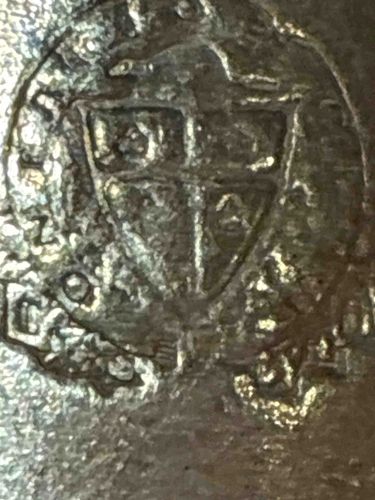
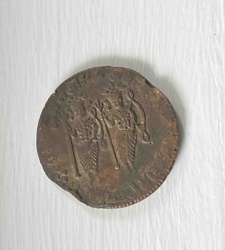
The item appears to be a heavily circulated coin or medal, likely made of a base metal such as copper or a copper alloy, given its dark, oxidized appearance. The surface exhibits a significant amount of wear and accretion, obscuring fine details. The primary visible feature is a central design resembling a shield or escutcheon, which is divided into multiple sections. Within this central emblem, there are faint, raised elements that might represent heraldic charges or symbols, though they are largely indistinct due to wear and surface texture. Surrounding this central design, there is a circular legend or inscription, with only a few letters discernable. On the left side, the characters 'Z B' followed by '3' are somewhat visible, while on the right, shapes resembling 'Y' or 'V' and 'I' can be faintly made out. The overall impression is one of age and extensive use, suggesting it has been handled frequently. The texture of the metal shows pitting and irregularities, indicative of environmental exposure or corrosion, rather than just smooth wear. The raised edges of the design elements are largely flattened, and the fields are dulled. The craftsmanship, though difficult to assess fully due to condition, suggests a struck piece, typical of coinage or medallions. Without clearer details of the inscription or central motif, specific identification of the issuing authority or date is challenging. However, the style points towards an older European origin, possibly from the 17th or 18th century, given the appearance of the heraldry and lettering style, though this is a preliminary assessment based on limited visual information. The visible condition issues include significant patination, surface abrasions, and a lack of sharp detail.
AI Appraisal Report
I have examined the image of this heavily circulated coin or medal with a heraldic shield motif. Its dark, oxidized appearance and significant wear suggest a base metal composition, likely copper or a copper alloy. The condition is poor; details within the central shield are largely indistinct, and the surrounding inscription is nearly illegible, with only faint 'Z B 3' on the left and 'Y/V I' on the right being discernible.
Authenticity, based solely on this image, cannot be definitively confirmed. While it appears to be a genuine struck piece consistent with period artifacts, the extreme wear and lack of clear identifiable features prevent any conclusive authentication. I would need to perform an in-person physical examination to assess the planchet characteristics, strike quality, and surface anomalies more thoroughly. Provenance documentation, if available, would significantly aid authentication, and metallurgical analysis could confirm composition and age.
Given the condition, rarity and demand are difficult to ascertain. Without clear identification (country, denomination, date), it primarily holds value as a curiosity or a 'filler' piece for a general collection of ancient or medieval coinage. Comparables for such unidentifiable, heavily worn base metal coins are typically in the very low monetary range.
The primary factors impacting value negatively are the severe wear, obscuring all meaningful details, and thus preventing specific identification. Its unidentifiable nature renders it largely valueless to specialist collectors. Therefore, the value is nominal.