AI Appraisal Estimate

AI-generated estimates · not official valuations

From the user

What was submitted

Photo and notes provided by the user — not generated by AI

Submitted item photo
Submitted photo · June 15, 2026

User's notes

Tapestry

AI analysis below

AI appraisal

AI analysis & estimate

AI-Generated · Verify before acting

Everything below is generated by AI for informational purposes only. AI can make mistakes — the AI may misidentify items or misattribute them (artist, maker, brand, designer, origin, era). This is not an official valuation and should not be used for insurance, sale, tax, estate, legal, or lending purposes — or any decision requiring a certified appraisal. It is not an authoritative claim about any person, brand, or rights holder — do not share or rely on it as a factual statement about a third party. Always consult qualified professionals before making financial decisions.

Note

This analysis also relies on unverified notes provided by the user, which may be incomplete or inaccurate and could affect the result.

Read the full disclaimer

AI Identification

·Not independently authenticated·Verify before acting

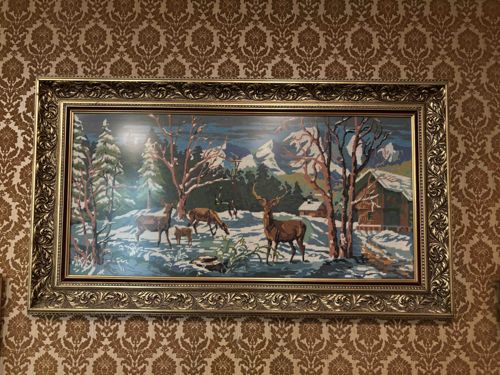
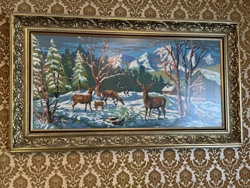
Woven Winter Alpine Landscape Tapestry

Decorative Arts / Textiles

AI Estimated Value

·Not an official valuation·Verify before acting

$450 - $650

As of June 15, 2026

AI Item Analysis

·AI can make mistakes·Verify before acting
This item is a large-format woven textile tapestry depicting a serene winter alpine scene, housed in an ornate, gilded rococo-style frame. The scene features a group of deer, including a prominent stag with antlers and a doe with a fawn, gathered in a snow-covered forest clearing near a rustic wooden chalet. The background showcases jagged, snow-capped mountain peaks under a dark, possibly twilight sky. The color palette is dominated by cool blues, crisp whites for the snow, and rich browns and greens for the wildlife and timber structures. The textile appears to be machine-loomed, likely from a cotton or synthetic blend, common in mid-20th-century European decor. The frame is a standout feature, exhibiting deep-relief acanthus leaf and floral carvings with an antiqued gold or bronze finish. While the tapestry surface seems well-preserved without visible tears or major staining, there is a slight ripple in the mounting, typical of textiles that have shifted over time. The overall style suggests a mid-to-late 20th-century production, likely originating from a Central European manufacturer (such as those in Germany or Belgium) where such 'gobelin' style scenic tapestries were popular for domestic foyers and dining rooms. The craftsmanship of the frame indicates a decorative rather than fine-art heritage, though it provides significant visual weight and presence.
AI Appraisal Report

·AI can make mistakes·Verify before acting
I have conducted a visual inspection of this large-format woven tapestry depicting an alpine winter scene. The piece is a classic example of mid-20th-century European mechanical looming, likely produced in Belgium or West Germany during the 1960s or 1970s. The 'gobelin' style machine weave utilizes a synthetic or cotton-blend thread to achieve high-contrast transitions in the snowy landscape and wildlife features. The condition appears fair to good; while the textile retains its vibrancy, visible rippling suggests the mounting has loosened, a common issue in larger scenic textiles. The value is bolstered significantly by the ornate, gilded rococo-style frame. While the frame is likely a composite or cast resin rather than hand-carved wood, it provides the 'decorator appeal' that current buyers in the secondary market seek for lodge-style or maximalist interiors. Current market demand for mid-century scenic tapestries is stable but modest, as they were mass-produced for the growing middle class of the era. Comparables sold at regional auctions usually range between $150 and $300 for the textile alone, with the high-impact frame doubling the valuation. Limitations: This appraisal is based solely on visual analysis of the provided images. To provide a definitive valuation, I would need an in-person examination to confirm the textile's fiber content (via a burn test) and to inspect the frame's reverse for manufacturer labels or structural cracks. I cannot verify the absence of moth damage or odors (smoke/pet) without physical inspection. For full authentication, provenance or original sales documentation from the mid-century period would be required.

Get your items appraised

Instant estimates of your treasures with AI-powered appraisals

Browse More Appraisals