AI estimate as of November 18, 2025 · verify with a professional before acting
AI-Generated · Verify before acting
Everything on this page is generated by AI for informational purposes only. AI can make mistakes — the AI may misidentify items or misattribute them (artist, maker, brand, designer, origin, era). This is not an official valuation and should not be used for insurance, sale, tax, estate, legal, or lending purposes — or any decision requiring a certified appraisal. It is not an authoritative claim about any person, brand, or rights holder — do not share or rely on it as a factual statement about a third party. Always consult qualified professionals before making financial decisions.
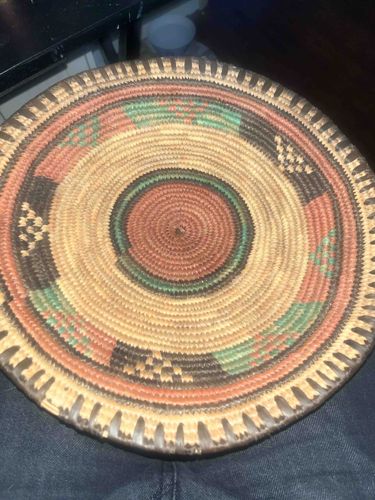
This item is a circular, coiled woven basket or platter, likely handcrafted from natural fibers. Its primary colors include natural tan/light brown from the base material, accented with dyed fibers in shades of reddish-orange, dark brown/black, and muted green. The design is concentric, starting with a reddish-brown spiral in the center, surrounded by rings of tan, a thin line of green, and then broader bands incorporating geometric patterns. These patterns feature angular blocks and smaller, repeating triangular or checkered motifs in dark brown/black and reddish-orange against the natural tan background. The rim of the basket is particularly distinctive, featuring a dark brown or black edge that is irregularly shaped, perhaps a leather or wrapped fiber finish, with a series of small, pointed or serrated projections around its circumference, adding a unique textural and visual element. The weaving technique appears to be coiled, indicating careful craftsmanship. The overall condition shows a visible patina that suggests age and use, with some slight fading and wear consistent with natural materials and time. There are no obvious signs of significant damage like breaks or unraveling, but the colors appear somewhat subdued, hinting at a vintage or antique origin. The unevenness in some of the colored sections and the slightly rustic finish of the rim further emphasize its handmade nature. The absence of visible maker's marks or signatures makes specific attribution difficult without further information, but the style is characteristic of indigenous or folk art weaving traditions.
AI Appraisal Report
Based on my visual examination of the provided image, this coiled woven decorative basket or platter presents as a genuine handcrafted item, likely of indigenous or folk art origin. The coiled weaving technique is consistent with traditional methods, and the natural fiber materials, along with the dyed accents, confirm its authenticity as a textile art piece. The visible patina, subdued colors, and slight wear are indicative of age and use, aligning with a vintage designation rather than a newly produced item. I assess the condition as good vintage condition; there are no apparent breaks or significant unraveling, although the colors have faded somewhat, which is expected with organic dyes and exposure over time. The unique, irregularly shaped dark rim adds character and suggests a handmade, rustic quality.
Market conditions for such handcrafted baskets are moderately strong, particularly for pieces with distinctive patterns and good preservation. Comparables often include Native American, African, or other global folk art baskets, with prices fluctuating based on tribal origin, age, size, and complexity of design. While this piece exhibits a pleasing aesthetic and careful craftsmanship, the absence of specific tribal attribution or maker information limits its upper market potential. Demand exists among collectors of ethnobotanical art, folk art, and decorator pieces. Rarity is difficult to ascertain without knowing its origin, but similar unique, well-preserved pieces are not exceedingly common.
The primary factors impacting its value are its handmade authenticity, good vintage condition, attractive concentric design, and the distinctive rim treatment. Conversely, the lack of provenance (e.g., origin, artist, age documentation) and specific tribal identification are significant limitations. Without physical inspection, I cannot confirm fiber types, examine the weave density in detail, or detect subtle repairs or structural weaknesses not visible in the image. An in-person examination would allow for tactile assessment of materials, a closer look at construction integrity, and potential hidden marks. Scientific testing could verify dye origins or age, and provenance documentation, if it existed, would be crucial for precise attribution and potentially higher valuation.