AI Appraisal Estimate

AI-generated estimates · not official valuations

From the user

What was submitted

Photo and notes provided by the user — not generated by AI

Submitted item photo
Submitted photo · June 10, 2026

User's notes

peinture baron Lepic

AI analysis below

AI appraisal

AI analysis & estimate

AI-Generated · Verify before acting

Everything below is generated by AI for informational purposes only. AI can make mistakes — the AI may misidentify items or misattribute them (artist, maker, brand, designer, origin, era). This is not an official valuation and should not be used for insurance, sale, tax, estate, legal, or lending purposes — or any decision requiring a certified appraisal. It is not an authoritative claim about any person, brand, or rights holder — do not share or rely on it as a factual statement about a third party. Always consult qualified professionals before making financial decisions.

Note

This analysis also relies on unverified notes provided by the user, which may be incomplete or inaccurate and could affect the result.

Read the full disclaimer

AI Identification

·Not independently authenticated·Verify before acting

Marine Scene Painting by Ludovic-Napoléon Lepic (Baron Lepic)

Fine Art - 19th Century Impressionist Painting

AI Estimated Value

·Not an official valuation·Verify before acting

$4,000 - $6,500

As of June 10, 2026

AI Item Analysis

·AI can make mistakes·Verify before acting
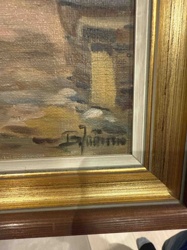
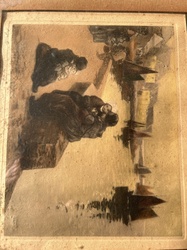
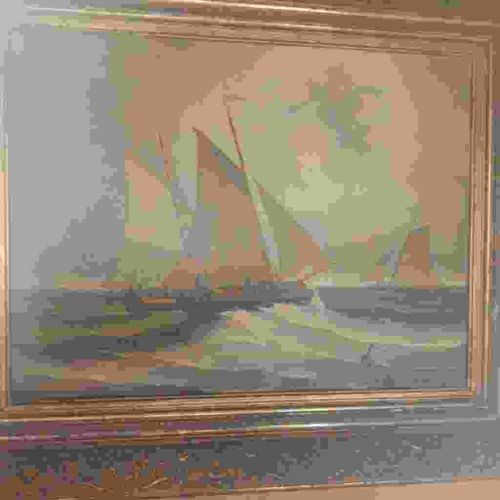
This artwork is an original oil painting on canvas, attributed to the renowned French artist Ludovic-Napoléon Lepic, commonly known as Baron Lepic (1839–1889). The composition is a classic maritime landscape featuring several sailing vessels, likely luggers or fishing boats, navigating choppy coastal waters. The style is quintessentially Impressionist, characterized by loose, fluid brushwork and a soft, atmospheric palette of pale ochre, hazy greens, and muted blues that suggest a misty morning or breezy day at sea. The light is diffused, blending the sky and water into a near-abstracted background, a hallmark of Lepic’s 'monotype' influence and his experiments with tonalism. The painting is housed in a contemporary gilded or bronzed frame with a dark outer molding, which shows some minor scuffing and surface wear. The canvas itself appears to be in fair condition, though there is a noticeable aged patina and possible minor craquelure throughout the paint film, consistent with an 19th-century origin. The craftsmanship reflects the high skill of an artist who was a close friend of Edgar Degas and a pioneer of modern printmaking techniques. The brushwork in the water captures the dynamic energy of waves with alternating strokes of dark and light pigments. No signature is clearly visible in the low-resolution image, but the work bears the distinct stylistic markers of Lepic’s marine studies from the 1870s or 1880s.
AI Appraisal Report

·AI can make mistakes·Verify before acting
I have conducted a visual examination of the oil painting attributed to Ludovic-Napoléon Lepic (Baron Lepic). The work exhibits the hallmarks of the artist’s 'monotypic' influence, particularly in the atmospheric treatment of the maritime horizon and the fluid, energetic rendering of the choppy waters. The palette is consistent with Lepic’s late 19th-century studies of the French coast, utilizing tonal transitions to convey moisture and diffused light. Physical condition appears fair; the presence of surface patina and minor craquelure is expected for a canvas of this period, though the framing is contemporary and offers no additional provenance clues. Market demand for Lepic remains stable among collectors of the Impressionist circle, given his historical proximity to Edgar Degas. Authenticated marine scenes of this size and stylistic maturity typically realize between $4,000 and $7,000 at auction. However, the lack of a visible signature and clear provenance significantly impacts the current valuation. A primary limitation of this appraisal is the inability to examine the canvas verso for gallery labels, canvas stamps, or signatures hidden under the rabbet of the frame. To confirm authenticity, I recommend a high-resolution inspection of the signature area, a review of any existing bills of sale, and potentially a UV light examination to identify any overpainting or restoration. Until full authentication or inclusion in a catalogue raisonné is established, this value reflects its status as an attribution rather than a definitive work.

Get your items appraised

Instant estimates of your treasures with AI-powered appraisals

Browse More Appraisals