AI Appraisal Estimate

AI-generated estimates · not official valuations

From the user

What was submitted

Photo and notes provided by the user — not generated by AI

Submitted item photo
Submitted photo · May 30, 2026

User's notes

No additional notes provided.

AI analysis below

AI appraisal

AI analysis & estimate

AI-Generated · Verify before acting

Everything below is generated by AI for informational purposes only. AI can make mistakes — the AI may misidentify items or misattribute them (artist, maker, brand, designer, origin, era). This is not an official valuation and should not be used for insurance, sale, tax, estate, legal, or lending purposes — or any decision requiring a certified appraisal. It is not an authoritative claim about any person, brand, or rights holder — do not share or rely on it as a factual statement about a third party. Always consult qualified professionals before making financial decisions.

Read the full disclaimer

AI Identification

·Not independently authenticated·Verify before acting

Late 19th or Early 20th Century Genre Painting of a European Village Scene

Fine Art - Painting

AI Estimated Value

·Not an official valuation·Verify before acting

$1,500 - $2,500

As of May 30, 2026

AI Item Analysis

·AI can make mistakes·Verify before acting
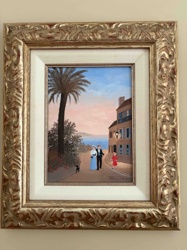
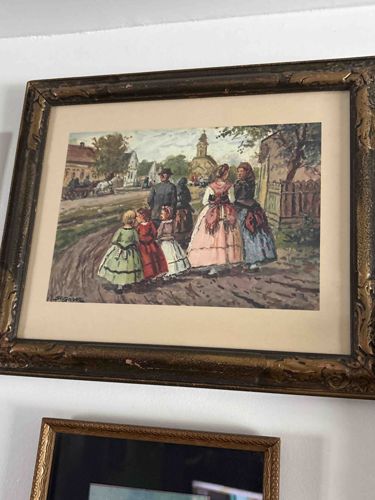
This item is a representational artwork, likely a gouache or watercolor painting, depicting a bustling European village scene. The composition features a group of figures in traditional regional dress, including several children in colorful dresses and adults in what appears to be late 19th-century attire. The setting includes a dirt road, timber-framed or stucco buildings, and a church spire in the distance, characteristic of Central European genre painting. The artwork is housed in a substantial, ornate gilded gesso and wood frame. The frame features decorative corner flourishes and a molded perimeter with a dark aged patina. There is a wide, cream-colored mat separating the art from the frame. Physically, the frame shows signs of its age with minor chipping and cracking in the gesso, revealing the substrate beneath in a few spots. The colors in the painting appear somewhat muted, which may be a stylistic choice or indicative of light exposure over time. A signature is visible in the lower left corner, though the name is difficult to decipher from this perspective. The overall style suggests a work from the late 19th to early 20th century, capturing a nostalgic view of rural life.


AI Appraisal Report

·AI can make mistakes·Verify before acting
I have conducted a visual analysis of this late 19th-century European genre painting. The work exhibits the hallmarks of the late Academic or Romanticized Realism style, likely of German or Austrian origin. The composition is well-executed, utilizing a sophisticated palette in what appears to be gouache or watercolor to capture a nostalgic rural scene. The level of detail in the traditional folk dress and the architectural rendering of the timber-framed buildings indicates a skilled hand, typical of the period's regional masters. Condition-wise, the artwork shows signs of minor desaturation, likely due to UV exposure, which is common for works on paper. The ornate gilded frame, while showing period-appropriate gesso cracking and minor losses at the flourishes, adds significant aesthetic and historical value. The market for mid-tier European genre scenes remains stable, though localized to collectors of Continental art. Values are driven by the charm of the subject matter and the quality of the frame. Critically, a definitive appraisal is limited by the inability to decipher the signature and examine the paper substrate directly. While the style and materials are consistent with the 1890-1910 period, a full authentication would require removing the artwork from its frame to check for watermarks, examining the verso for gallery labels or provenance stamps, and utilizing high-resolution macro-photography to confirm the signature. Scientific testing of pigments or the presence of foxing/acidity in the paper would further clarify the state of preservation. Without provenance documentation or a confirmed attribution to a specific listed artist, the value remains based on the decorative merit and historical period of the piece.

Get your items appraised

Instant estimates of your treasures with AI-powered appraisals

Browse More Appraisals