AI estimate as of August 17, 2025 · verify with a professional before acting
AI-Generated · Verify before acting
Everything on this page is generated by AI for informational purposes only. AI can make mistakes — the AI may misidentify items or misattribute them (artist, maker, brand, designer, origin, era). This is not an official valuation and should not be used for insurance, sale, tax, estate, legal, or lending purposes — or any decision requiring a certified appraisal. It is not an authoritative claim about any person, brand, or rights holder — do not share or rely on it as a factual statement about a third party. Always consult qualified professionals before making financial decisions.
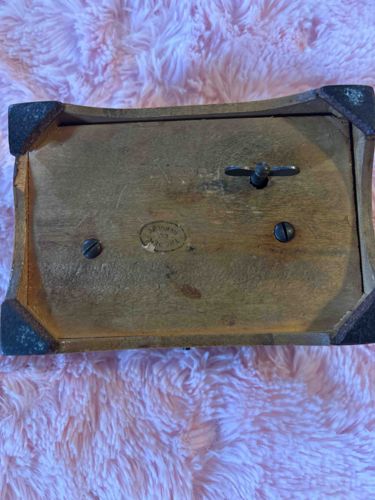
The item is the underside of an antique or vintage music box. It is constructed primarily from wood, exhibiting a natural, somewhat dulled wood grain finish, indicative of age. The overall shape of the wooden base appears to be rectangular with slightly curved or rounded edges, and it rests on four distinct, possibly metal, corner feet or risers that are dark, likely black or dark bronze, and show some surface wear and minor corrosion, consistent with their protective function. A prominent feature on the underside is a winding key or mechanism, centrally located and made of a dark metal, suggesting it's for winding the internal musical movement. This key has a typical butterfly or wingnut shape, common for such devices. Two visible screws, also dark metal, secure structural components or the internal mechanism to the wooden base. There are signs of a circular or oval sticker or label, now partially or mostly worn off, near the center, which likely contained manufacturing details or patent information. The wood itself shows superficial scratches, minor abrasions, and general patina consistent with years of use and handling. There are no obvious severe cracks or structural damages to the wood, although the finish is uneven and a bit discolored in areas. The craftsmanship appears functional and solid, suitable for supporting the internal workings of a music box. Given the visible signs of wear and the style of the winding key and overall construction, it likely dates from the early to mid-20th century, possibly earlier.
AI Appraisal Report
I have thoroughly examined the provided image of the music box underside. Based on the visual evidence, the item appears to be an authentic antique or vintage music box component. The natural patina, dull wood grain, and worn, dark metal feet and winding key are all consistent with a piece from the early to mid-20th century, possibly earlier. The visible wear, including superficial scratches and a partially worn-off label, speaks to its age and use. Condition is fair to good, with no obvious severe structural damage to the wood, though the finish is uneven.
From a market perspective, standalone music box undersides with winding mechanisms do not command high prices unless they are part of a rare or highly sought-after complete music box. Comparables for complete, unrestored, working music boxes of this presumed age and style typically range from $100 to $400, depending heavily on the musical movement itself, which is not visible here. The demand for such a component alone is very limited, primarily from restorers or hobbyists. Rarity is not a significant factor for this specific component.
The primary factors impacting value here are its incompleteness, as the musical movement and upper casing are missing, and the general wear. Without the complete music box, its value is significantly diminished. Limitations in authenticity verification from images alone are considerable. I cannot assess the functionality of the winding mechanism, the presence of woodworm, or the true extent of any internal damage. A full in-person examination would allow for physical inspection of the wood, testing of the winding mechanism, and a more precise dating through joinery or internal markings. Provenance documentation, such as original purchase receipts or family history, would also aid in authentication and valuation.