AI estimate as of September 17, 2025 · verify with a professional before acting
AI-Generated · Verify before acting
Everything on this page is generated by AI for informational purposes only. AI can make mistakes — the AI may misidentify items or misattribute them (artist, maker, brand, designer, origin, era). This is not an official valuation and should not be used for insurance, sale, tax, estate, legal, or lending purposes — or any decision requiring a certified appraisal. It is not an authoritative claim about any person, brand, or rights holder — do not share or rely on it as a factual statement about a third party. Always consult qualified professionals before making financial decisions.
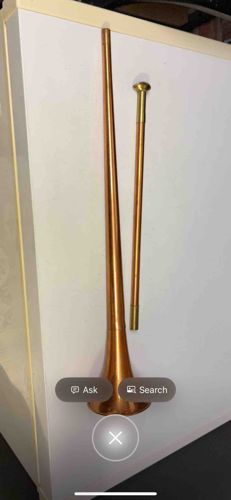
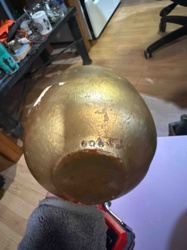
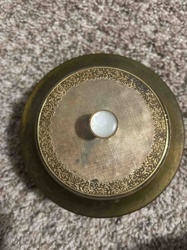
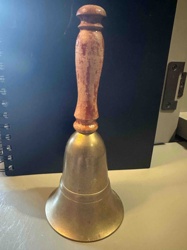
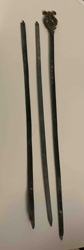
The item consists of two distinct components, both appearing to be crafted from polished brass or a brass-toned metal, likely copper or a copper alloy, given the warm, reddish-gold hue and visible luster. The primary component is a long, conical tube that flares significantly at one end, resembling the bell and leadpipe section of a bugle or trumpet, though it lacks valves or further tubing. It has a smooth, unadorned surface, suggesting a deliberate simplicity in its design. The total length of this piece is substantial, extending from the bottom of the image upwards. The flared bell section displays a smooth, continuous curve, indicative of quality metalworking. The second component is a slender, straight rod with a decorative, spherical or mushroom-shaped finial at one end, rendered in the same brassy material. The opposite end of this rod tapers slightly, and it appears to be designed to either function as a mouthpiece or to be inserted into the main conical piece, possibly as a cleaning rod or a part of a larger musical instrument assembly. Both pieces exhibit a high degree of polish, with visible reflections on their surfaces. There are no obvious dents, significant scratches, or signs of heavy wear visible in the provided image, suggesting good to excellent condition, or that it has been well-maintained or recently polished. No manufacturer's marks, signatures, or specific engravings are discernible from the image. Its unornamented nature hints at either a functional piece, a component of a larger assembly, or a minimalist decorative object. The craftsmanship appears competent, with smooth transitions and even coloring across the observed surfaces.
AI Appraisal Report
Based on my visual examination of the provided image, the item, described as a bugle or trumpet-style bell and a detachable mouthpiece/rod, appears to be in very good to excellent cosmetic condition. The polished brass or brass-toned metal exhibits a warm luster with no visible dents, significant scratches, or signs of heavy wear, suggesting careful maintenance or recent polishing. The craftsmanship, particularly the smooth, continuous curve of the bell, appears competent. Without any discernible manufacturer's marks, signatures, or engravings, its authenticity as a specific historical or branded musical instrument component is impossible to verify from imagery alone.
This piece lacks the complex mechanisms (valves, full tubing) of a functional bugle or trumpet, suggesting it is either a component of a larger, incomplete instrument, a practice/display piece, or a decorative object. The 'mouthpiece/rod' is unusual; if it were a functional mouthpiece, its form is atypical, and if a cleaning rod, it’s quite elaborate. This ambiguity limits its potential as a highly valued musical artifact.
Market conditions for incomplete musical instrument components or purely decorative brass items are generally lower than for complete, functional instruments, especially those from renowned makers. Demand for such an item would likely come from collectors of brass instruments, prop masters, or individuals seeking vintage-style decorative objects. While the condition is excellent, the lack of definitive origin, intended function, and the absence of a complete instrument significantly limit its rarity and overall market value.
Factors impacting value positively are its excellent preserved condition and appealing aesthetic; negatively, its incompleteness and lack of identifiable maker or historical context. For full authentication, I would need a physical inspection to assess material composition, internal bore condition, and any hidden marks. Provenance documentation could significantly increase value. Given these limitations, I estimate its value to be in the range of $40-$100, primarily as a decorative piece or a component for a hobbyist.