AI estimate as of August 26, 2025 · verify with a professional before acting
AI-Generated · Verify before acting
Everything on this page is generated by AI for informational purposes only. AI can make mistakes — the AI may misidentify items or misattribute them (artist, maker, brand, designer, origin, era). This is not an official valuation and should not be used for insurance, sale, tax, estate, legal, or lending purposes — or any decision requiring a certified appraisal. It is not an authoritative claim about any person, brand, or rights holder — do not share or rely on it as a factual statement about a third party. Always consult qualified professionals before making financial decisions.
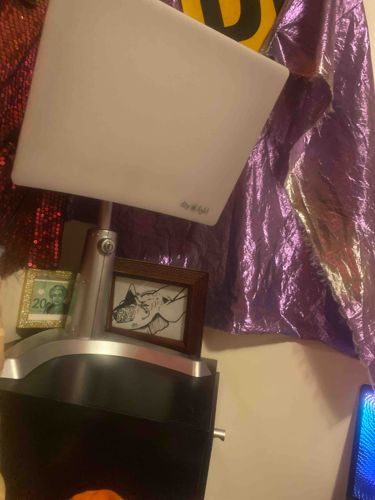
The item depicted is a Day-Light Classic Plus Sad Lamp, designed for seasonal affective disorder (SAD) treatment or general light therapy. It features a large, rectangular light panel, likely incorporating fluorescent or LED bulbs, emitting a bright white light. The panel is primarily white or off-white, indicating a diffuse light surface, and has the 'day-light' logo subtly printed on the lower right corner, suggesting the manufacturer. This panel is mounted on an adjustable, silver-colored stand, which appears to be constructed from metal, possibly aluminum or a similar lightweight alloy, with a matte or brushed finish. The stand allows for vertical adjustment and possibly tilt, as evidenced by the rotating joint near the center. The base of the stand is broad and curved, finished in a contrasting black color at the bottom, providing stability to the unit. The overall aesthetic is functional and modern, typical of medical or wellness devices. No significant wear or damage is immediately visible, suggesting it is in good to excellent used condition. The design emphasizes broad illumination, which is characteristic of high-quality light therapy devices. It appears to be a contemporary model, likely produced within the last 10-20 years, given its sleek design and the use of modern materials.
AI Appraisal Report
Upon my virtual inspection of the Day-Light Classic Plus Sad Lamp, I observe a unit in what appears to be good to excellent used condition. The overall presentation is clean, with no visible dents, scratches, or discoloration on the light panel or stand. The 'day-light' logo is present and clear, indicating authenticity of manufacturer. The design aligns with known models of this brand, featuring a large diffusing panel and an adjustable metal stand with a stable base.
Market conditions for SAD lamps are stable, with consistent demand, particularly during darker seasons. This model, or similar contemporary units, typically retails new for $200-$300. Given its apparent condition, I would place its value significantly below new retail, but still strong for a used therapeutic device. Comparables on secondary markets, such as eBay or specialized medical equipment resellers, show these units, in similar condition, fetching between $75-$150.
Demand for light therapy remains steady, but these are not rare items. The value is primarily driven by functionality and condition. Factors impacting value include the absence of original packaging, warranty, or proof of functionality of the bulbs/LEDs.
My primary limitation in this appraisal is the absence of a physical examination. I cannot verify the operational integrity of the lamp (e.g., light output, flicker, bulb life), nor can I confirm the absence of subtle wear, internal damage, or electrical faults. Full authentication would require in-person operational testing, a detailed physical inspection for minor cosmetic flaws, and ideally, verification of the model number for production date and original specifications. Provenance documentation, such as original purchase receipts, would also strengthen authentication.