AI estimate as of September 29, 2025 · verify with a professional before acting
AI-Generated · Verify before acting
Everything on this page is generated by AI for informational purposes only. AI can make mistakes — the AI may misidentify items or misattribute them (artist, maker, brand, designer, origin, era). This is not an official valuation and should not be used for insurance, sale, tax, estate, legal, or lending purposes — or any decision requiring a certified appraisal. It is not an authoritative claim about any person, brand, or rights holder — do not share or rely on it as a factual statement about a third party. Always consult qualified professionals before making financial decisions.
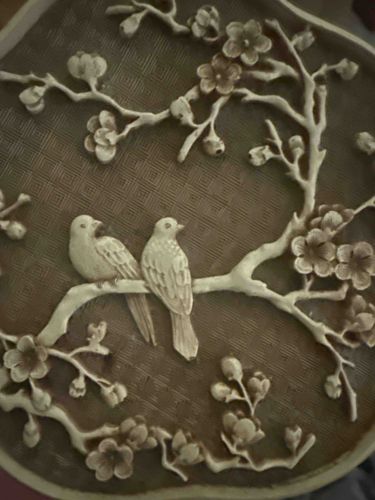
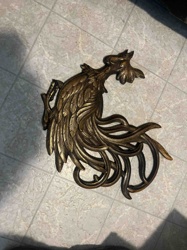
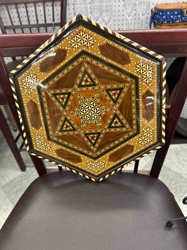
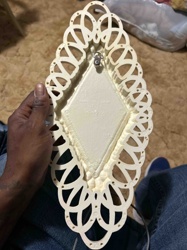
This item is a relief carved wall art plaque depicting two birds perched on a branch of a plum or cherry blossom tree. The overall shape appears to be circular or octagonal with rounded corners, though only a portion is visible, framed by a subtly raised edge. The primary colors are an off-white or light ivory for the carved elements, set against a darker, possibly deep brown or bronze background. The background features a finely textured, geometric pattern resembling a diamond or cross-hatch motif, providing a contrasting base for the raised carving. The carved branch, birds, and blossoms exhibit considerable detail and dimensionality, indicating skilled craftsmanship. The two birds are facing each other, rendered with individual feathers and characteristic avian postures. The tree branch itself is organic and flowing, adorned with numerous blossoms and buds in various stages of bloom. Some of the blossoms appear to have a slightly darker tone in their centers, suggesting either natural shading, a different material inlay, or age-related discoloration. No explicit maker's marks, signatures, or stamps are discernible from the image. The style suggests an East Asian aesthetic, possibly inspired by traditional Chinese or Japanese art, and could be made from resin, ivory, bone, or a composite material designed to imitate these. Given the appearance, it likely dates from the mid-20th century onwards. The condition appears to be good, with no obvious cracks, chips, or significant damage, though some light surface dust or minor patina consistent with age might be present in the crevices. The relief depth adds a tactile quality and visual interest to the piece.
AI Appraisal Report
Upon visual examination of this relief carved wall art plaque, I have assessed its value based on the provided image and description. The piece depicts a traditional East Asian motif of two birds on a plum blossom branch, rendered in high relief against a textured background. The craftsmanship appears competent, with good detail in the feathers and blossoms, suggesting it is a well-made decorative item rather than a fine art carving.
The condition appears to be very good, with no visible cracks, chips, or significant damage. The primary factor influencing value is the material. While the carving resembles ivory or bone, it is most likely a molded resin or composite material, a common practice for decorative items produced in the mid-to-late 20th century. This assumption significantly tempers the valuation. The market for such decorative, mass-produced Asian-style decor is generally accessible, with similar resin plaques being quite common.
Demand for this style is moderate, often sought by those decorating in Chinoiserie or traditional Asian themes. It lacks the rarity or known artisan signature that would elevate its price. The primary driver of its value is its aesthetic and decorative quality.
It is crucial to note the limitations of this appraisal. Without physical inspection, I cannot definitively determine the material. An in-person examination would allow for testing the material's properties (e.g., thermal conductivity, surface texture, weight) to distinguish resin from organic materials like ivory or bone. Scientific testing or provenance documentation would be required for full authentication, which could dramatically alter the value if it were proven to be genuine carved ivory.