AI estimate as of December 15, 2025 · verify with a professional before acting
AI-Generated · Verify before acting
Everything on this page is generated by AI for informational purposes only. AI can make mistakes — the AI may misidentify items or misattribute them (artist, maker, brand, designer, origin, era). This is not an official valuation and should not be used for insurance, sale, tax, estate, legal, or lending purposes — or any decision requiring a certified appraisal. It is not an authoritative claim about any person, brand, or rights holder — do not share or rely on it as a factual statement about a third party. Always consult qualified professionals before making financial decisions.
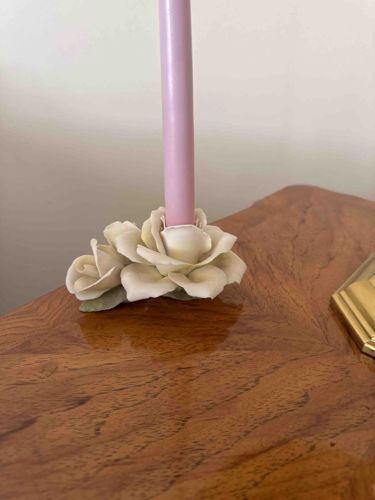
This item is a charming candlestick holder crafted from what appears to be bisque porcelain, or possibly a similar unglazed ceramic material, designed in the form of intertwined roses. It features a central receptacle to hold a single taper candle, currently occupied by a light pink, probably wax, taper candle. The floral arrangement consists of two primary rose blossoms and what appears to be a smaller bud, all rendered in a soft, off-white or cream color, with subtle green accents suggesting foliage peeking from underneath the petals. The petals exhibit a delicate, slightly translucent quality, indicative of fine porcelain work, and are individually shaped and layered to give a realistic, three-dimensional effect to the flowers. The construction suggests hand-modeling or intricate mold work, followed by careful finishing. There are no visible chips, cracks, or significant damage to the porcelain, and the coloration appears consistent and untarnished, suggesting good preservation. The unglazed finish gives the piece a matte, somewhat powdery texture. The craftsmanship indicates a decorative, possibly vintage, style, likely from the mid-to-late 20th century. Its small size suggests it is designed for a single standard taper candle, making it suitable for a mantelpiece, side table, or as part of a centerpiece. The absence of apparent maker's marks in the visible areas prevents precise attribution.
AI Appraisal Report
Based on my visual examination of the provided image, this floral porcelain candlestick holder is in excellent condition. There are no visible chips, cracks, or significant damage, and the coloration appears consistent and untarnished, suggesting careful preservation. The unglazed finish, likely bisque porcelain, gives it a delicate, matte appearance. The craftsmanship, particularly the individually shaped and layered petals, points to either skilled hand-modeling or intricate mold work. Authenticity, based solely on imagery, is challenging for un-marked decorative ceramics. Without producer markings, country of origin, or specific material analysis, I cannot definitively ascribe it to a particular maker or period, though it generally aligns with mid-to-late 20th-century decorative trends.
Market conditions for vintage decorative porcelain candlestick holders of this type are generally moderate. While charming, pieces lacking identifiable makers or significant historical context tend to command lower values. Comparables in online marketplaces often fall within a similar range for well-preserved, unmarked floral bisque or unglazed ceramic items. Demand is present but not high, primarily from collectors of vintage decor or those seeking accent pieces. Rarity is not a significant factor here, as similar floral designs were mass-produced by various manufacturers. Factors impacting value include its pristine condition, which maintains its aesthetic appeal, and its classic design. The primary limitation in this appraisal is the lack of maker's marks or provenance documentation. For full authentication and a more precise valuation, a physical in-hand inspection would be necessary to assess the porcelain quality more closely (e.g., translucency, weight, firing consistency), and to search for any faint or hidden marks. Scientific testing for material composition would provide further certainty, but is typically not economically justified for items in this price range.