AI estimate as of November 4, 2025 · verify with a professional before acting
AI-Generated · Verify before acting
Everything on this page is generated by AI for informational purposes only. AI can make mistakes — the AI may misidentify items or misattribute them (artist, maker, brand, designer, origin, era). This is not an official valuation and should not be used for insurance, sale, tax, estate, legal, or lending purposes — or any decision requiring a certified appraisal. It is not an authoritative claim about any person, brand, or rights holder — do not share or rely on it as a factual statement about a third party. Always consult qualified professionals before making financial decisions.
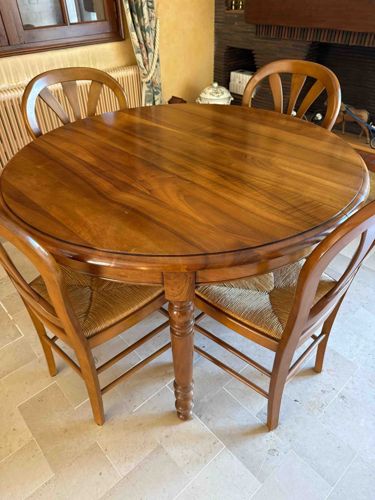
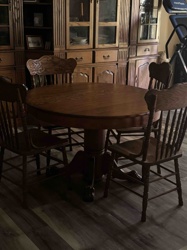
This item is a dining set consisting of a round wooden table and four matching wooden chairs. The table features a solid, round top crafted from what appears to be a medium-toned hardwood, likely walnut or a similar wood given its rich grain patterns and reddish-brown hue. The tabletop exhibits a desirable, slightly wavy grain, indicating quality timber and potentially solid wood construction rather than veneer. It has a smooth, polished finish, reflecting light evenly. The edge of the table appears to have a subtle ogee or rounded profile, adding a touch of elegance. The table is supported by a single central pedestal leg, which is turned and carved, featuring several rings and bulbous sections, contributing to a traditional or perhaps provincial style. The leg terminates in multiple splayed feet, though these are not fully visible.
The four chairs accompanying the table are also made of a matching medium-toned hardwood, featuring a curved spindle or slatted backrest design. The seat of each chair is woven from what appears to be natural rush or straw, showing a herringbone or similar intricate pattern, which adds texture and a rustic charm. The chairs have simple, sturdy legs with stretchers for added stability.
Overall, the set presents a cohesive and warm aesthetic. Visible condition issues are minimal from the provided image; the wood appears well-maintained with a consistent sheen, suggesting a good quality finish. There are no obvious deep scratches, dents, or significant wear marks visible on the tabletop or chairs. The rush seats appear intact with no major fraying or tears. The style suggests a traditional, possibly French Provincial or country-style dining set, likely from the mid-20th century or later, designed for a cozy dining area. The craftsmanship, particularly the turned leg of the table and the woven seats of the chairs, indicates a good level of detail and quality in its construction.
AI Appraisal Report
Upon visual examination of the provided image, this round dining table with four matching chairs appears to be a well-preserved example of a traditional or country-style dining set. The medium-toned hardwood, likely walnut or a similar quality timber, displays attractive grain patterns, suggesting solid wood construction for the tabletop. The turned and carved pedestal leg of the table, along with the spindle-back chairs and woven rush seats, point towards a French Provincial or rustic aesthetic, possibly dating from the mid-20th century onwards. The craftsmanship, particularly in the turning and rush weaving, indicates a good level of detail.
The condition appears very good; the wood exhibits a consistent sheen with no visible major scratches, dents, or significant wear. The rush seats seem intact without obvious fraying. This excellent condition enhances its market appeal. Market conditions for well-maintained vintage dining sets in this style are generally stable, with demand from individuals seeking character pieces for interiors. Comparable sets of good quality, but not high-end designer, typically fetch in the range of $500 to $1,000 depending on locale and seller. Factors impacting value positively include the cohesive design, apparent solid wood construction, and excellent condition.
However, it is crucial to note the limitations of an appraisal based solely on images. I cannot definitively confirm wood type, construction methods (e.g., solid wood vs. veneer in less visible areas), or the true condition of joints and unseen surfaces without an in-person examination. Provenance documentation could help establish a more precise manufacturing date or maker, which would also impact value. Scientific testing is not typically applied to these types of furnishings for authentication. My valuation reflects the visual assessment of quality and condition for a secondary market.