AI estimate as of September 29, 2025 · verify with a professional before acting
AI-Generated · Verify before acting
Everything on this page is generated by AI for informational purposes only. AI can make mistakes — the AI may misidentify items or misattribute them (artist, maker, brand, designer, origin, era). This is not an official valuation and should not be used for insurance, sale, tax, estate, legal, or lending purposes — or any decision requiring a certified appraisal. It is not an authoritative claim about any person, brand, or rights holder — do not share or rely on it as a factual statement about a third party. Always consult qualified professionals before making financial decisions.
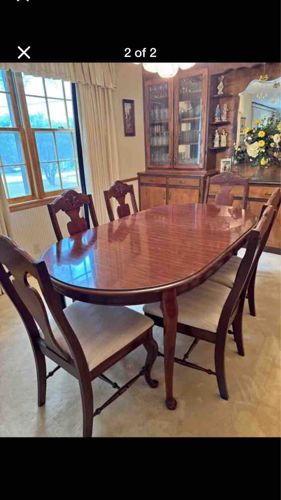
This item is a traditional dining room set, consisting of an oval-shaped dining table and six matching dining chairs. The table features an elegant reeded or banded edge and appears to be constructed from a rich, reddish-brown wood, likely mahogany or cherry, with a highly polished, reflective finish that shows some graining. The surface of the table exhibits a slight ripple or tiger-stripe effect in the wood grain, which adds to its visual appeal. The table is supported by four sturdy, tapered legs, which are relatively unadorned. There are no visible leaves in the current configuration, but the design suggests it might be expandable. The six chairs complement the table's aesthetic perfectly. Two of the chairs appear to have elaborately carved top rails with ornate pierce-carved splats, indicative of a host/hostess chair design, while the other four chairs (visible in part) have simpler, possibly pierced backrests with a more understated design. All chairs feature upholstered seats in a light, neutral-toned fabric, possibly a linen or damask, which contrasts gently with the dark wood frame. The chair legs are cabriole-style with a gentle curve, terminating in a simple foot. Some chairs show stretchers between the legs for added stability. The overall condition appears to be good, with a well-maintained finish on the table, though minor surface wear consistent with age and use (e.g., slight scratches or scuffs on legs, light wear on upholstery) might be present but are not clearly discernible from the image alone. The set exhibits classic design elements suggesting a Queen Anne or early American Colonial revival style, likely dating from the mid-20th century to late 20th century.
AI Appraisal Report
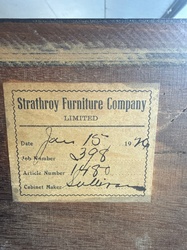
Upon visual examination of this traditional dining room set, consisting of an oval dining table and six matching chairs, I assess its condition to be good. The highly polished finish of the reddish-brown wood (likely mahogany or cherry) on the table appears well-maintained, exhibiting a pleasing grain. Minor surface wear consistent with age and use, such as light scratches or scuffs, are not clearly visible but are often expected with pieces of this vintage. The upholstery on the chairs seems clean and neutral. Authenticity-wise, the design elements, particularly the reeded edge, tapered table legs, and cabriole chair legs with carved splats on the host chairs, strongly suggest a Queen Anne or Colonial Revival style, likely manufactured between the mid to late 20th century. This is a mass-produced, traditional style, not a rare antique. Market conditions for traditional dining sets are currently somewhat soft, with demand for these styles being moderate. While solid wood construction is desirable, sets from this period are not considered rare. Factors impacting value positively include the complete matching set and apparently good condition. Negatively, the age and widespread availability of similar styles keep the value in the mid-range. For full authentication and a more precise value, an in-person examination would be crucial to assess the wood type definitively, inspect for structural integrity (e.g., loose joints), identify any hidden repairs, and determine the exact condition of the finish and upholstery. Provenance documentation could help confirm the manufacturer and precise age, which could impact value, especially if from a known high-quality maker. Scientific testing is not typically required for items of this type and era.