AI estimate as of July 5, 2025 · verify with a professional before acting
AI-Generated · Verify before acting
Everything on this page is generated by AI for informational purposes only. AI can make mistakes — the AI may misidentify items or misattribute them (artist, maker, brand, designer, origin, era). This is not an official valuation and should not be used for insurance, sale, tax, estate, legal, or lending purposes — or any decision requiring a certified appraisal. It is not an authoritative claim about any person, brand, or rights holder — do not share or rely on it as a factual statement about a third party. Always consult qualified professionals before making financial decisions.
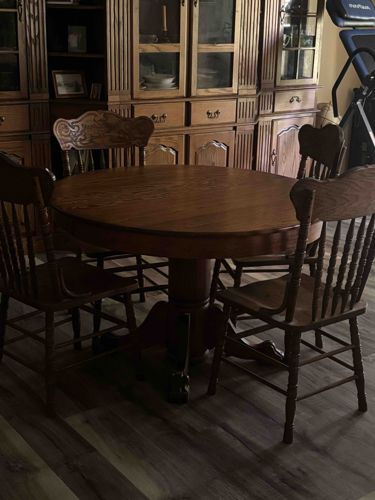
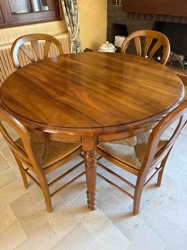
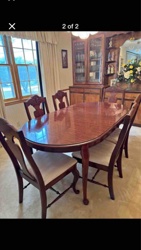
This item is a traditional dining room set, likely consisting of a round pedestal table and several accompanying wooden chairs. The table features a solid, round top crafted from what appears to be oak or a similar hardwood, exhibiting a medium-to-dark brown stain with a visible wood grain, suggesting a natural finish. The surface appears smooth with a slight sheen, indicative of a clear protective coat. The base of the table is a robust pedestal style, with a substantial central column that branches into four carved, Queen Anne or cabriole-style legs, terminating in what appear to be simple scrolled feet, providing stability. The color of the table and chairs is consistent, suggesting they are a matched set or from the same production period.
The chairs are constructed from matching wood and feature turned front legs and stretchers for stability. The chair backs are a combination of a shaped, ornate top rail, possibly with carved embellishments (one chair back clearly shows decorative carving in the upper section), and vertical spindles or slats forming the main backrest. The seats appear to be solid, contoured wood, possibly saddle-shaped for comfort. The overall style points to a Victorian, Arts and Crafts, or early 20th-century American farmhouse aesthetic, possibly dating from the late 19th to mid-20th century. There are no visible major condition issues such as cracks, severe scratches, or breaks from the provided image, but typical wear consistent with age and use, such as minor surface abrasions, scuffs on the legs, or slight fading of the finish, would be expected upon closer inspection. The craftsmanship appears solid and functional, characteristic of durable, mass-produced or semi-custom furniture from that period. There are no discernible maker's marks or signatures visible in the image.
AI Appraisal Report
Based on my visual examination of the provided image, this Traditional Wooden Pedestal Dining Table and Windsor/Spindle Back Chairs set appears to be in good overall condition for its age. I observe no major structural damage such as large cracks, breaks, or significant warping. The consistent medium-to-dark brown stain and visible wood grain suggest a solid hardwood, likely oak, with a protective finish that still retains a sheen. The design elements, including the Queen Anne or cabriole-style legs on the pedestal table and the turned legs, spindle backs, and carved elements on the chairs, are consistent with furniture produced from the late 19th to mid-20th century, aligning with Victorian, Arts and Crafts, or American farmhouse aesthetics. The craftsmanship appears sturdy, characteristic of functional, mass-produced or semi-custom furniture from that period.
Market conditions for traditional wooden dining sets like this are stable, with a consistent demand from buyers seeking classic aesthetics and durable construction. Comparable sets of similar age and style often sell in the mid-range. While not exceedingly rare, a well-preserved matched set adds value. Factors impacting value include the overall intactness of the finish, the absence of major repairs, and the solidity of the joints. Typical minor wear such as scuffs, abrasions, and slight fading would be expected and do not significantly devalue the set given its probable age.
It is crucial to note the limitations of authenticating solely from images. Without a physical inspection, I cannot confirm the exact wood species, the integrity of all joinery, or the presence of subtle structural issues (e.g., loose joints, hairline cracks not visible in the image).
For full authentication and a more precise value, an in-person examination is essential. This would allow me to check for maker's marks or labels (none are visible in the image), assess the condition of all surfaces and structural components firsthand, and potentially perform tests for wood type. Provenance documentation, if available, would also significantly aid in confirming the item's age and history.