AI estimate as of October 4, 2026 · verify with a professional before acting
AI-Generated · Verify before acting
Everything on this page is generated by AI for informational purposes only. AI can make mistakes — the AI may misidentify items or misattribute them (artist, maker, brand, designer, origin, era). This is not an official valuation and should not be used for insurance, sale, tax, estate, legal, or lending purposes — or any decision requiring a certified appraisal. It is not an authoritative claim about any person, brand, or rights holder — do not share or rely on it as a factual statement about a third party. Always consult qualified professionals before making financial decisions.
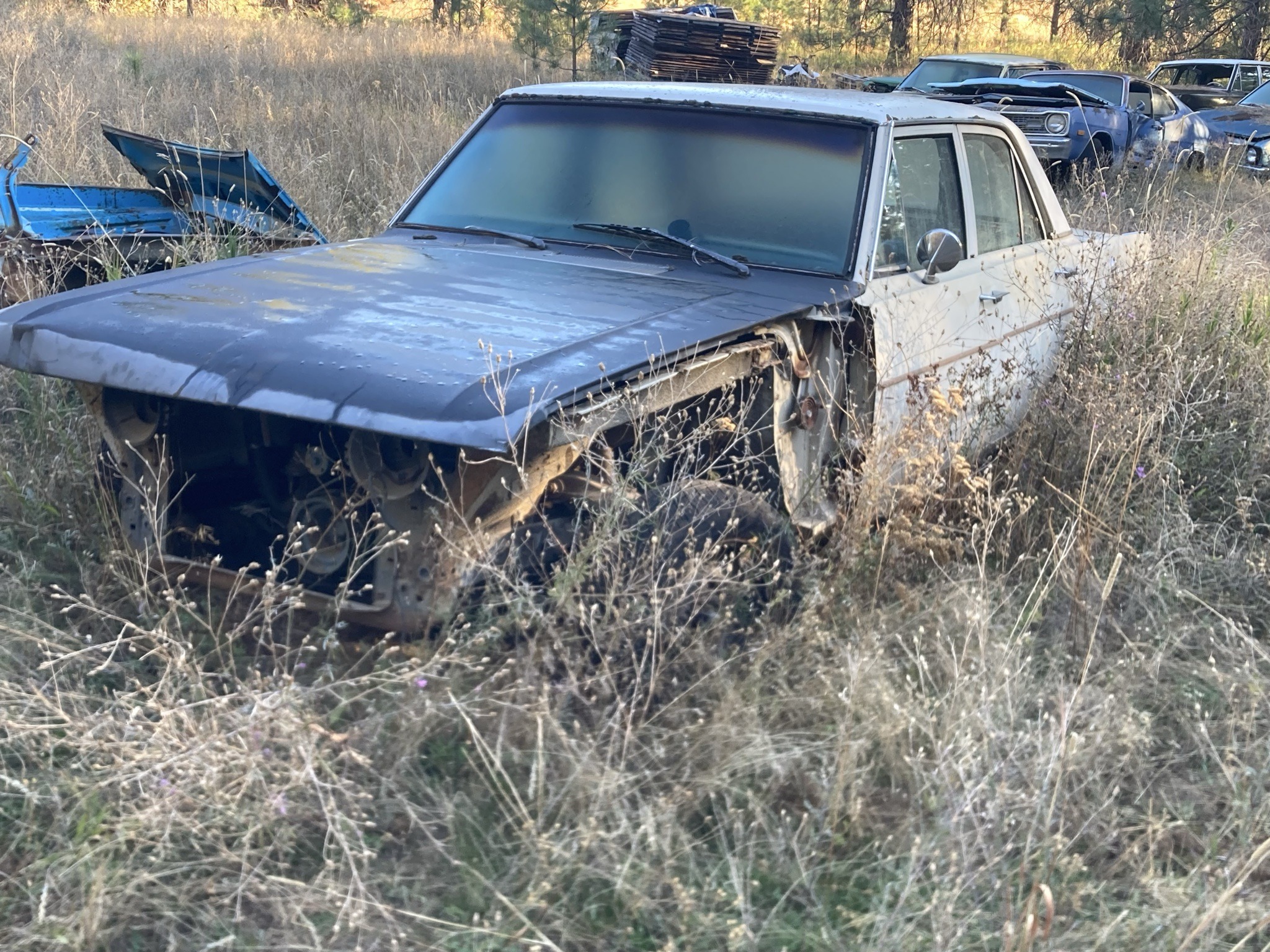
This image shows a vintage four-door sedan automobile resting in an overgrown grassy field, heavily weathered and partially disassembled. The vehicle features a boxy body style consistent with mid-to-late 20th-century American automotive design, characterized by a distinct three-box configuration, angular roofline, and flat glass windshield. The exterior displays significant weathering, fading paint, oxidation, and surface rust throughout the body panels. The front end is missing its grille, bumper, and headlights, exposing the empty engine bay and front frame components. The hood appears to be a replacement panel, showing a dark, matte finish contrasting with the lighter body color. A single side mirror is mounted on the driver-side door. The interior is obscured behind dusty glass, though a steering wheel and dashboard outline are faintly visible. Tires and wheels are partially sunken into the dirt and overgrown vegetation. Other classic cars are visible in the background, suggesting a salvage yard or rural storage setting. There are no clearly visible maker's marks, badges, or serial numbers in this view, so the identification rests purely on the overall body silhouette and stylistic features typical of vintage automobiles from the era. The item is in poor, non-running salvage condition with severe structural and cosmetic degradation.
AI Appraisal Report
Based on what I can see in the provided image, this vehicle appears to be a vintage four-door sedan resting in a salvage yard or rural storage setting, exhibiting severe weathering, heavy oxidation, surface rust, and missing front-end components. I cannot verify from a photo the exact make, model, year, or internal mechanical condition, and physical inspection would be needed to confirm the structural integrity and completeness of the chassis and powertrain. The basis for the value estimate considers the car strictly as a donor vehicle or parts car for automotive restoration projects. General market conditions and demand for unrestored vintage sedans in salvage condition are typically speculative, driven primarily by hobbyists seeking specific hard-to-find trim pieces, glass, or structural panels rather than running potential. Because there are no clearly visible maker's marks, badges, or serial numbers in this view, the identification rests purely on the overall body silhouette. To confirm the identity, condition, and potential salvage value of the automobile, an in-person physical examination, decoding of any hidden VIN or data plates, and assessment by a vintage automotive specialist would be necessary. If this vehicle turns out to be a heavily modified replica, an unidentifiable model, or too structurally compromised to yield usable parts, the market value would drop to scrap metal value, typically ranging from $100 to $250.