AI estimate as of October 2, 2025 · verify with a professional before acting
AI-Generated · Verify before acting
Everything on this page is generated by AI for informational purposes only. AI can make mistakes — the AI may misidentify items or misattribute them (artist, maker, brand, designer, origin, era). This is not an official valuation and should not be used for insurance, sale, tax, estate, legal, or lending purposes — or any decision requiring a certified appraisal. It is not an authoritative claim about any person, brand, or rights holder — do not share or rely on it as a factual statement about a third party. Always consult qualified professionals before making financial decisions.
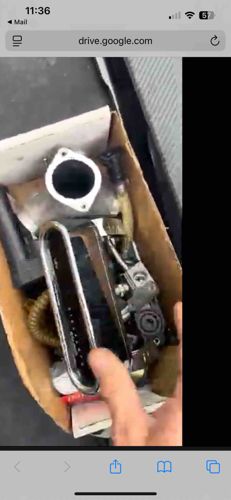
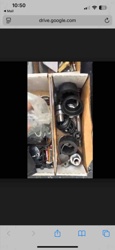
The image displays a collection of assorted automotive components, primarily appearing to be engine or exhaust system related parts, consolidated within a simple brown cardboard box. Prominently featured is a metallic component, likely made of cast iron or aluminum, with a circular opening at one end surrounded by a four-bolt flange, indicating it could be an exhaust manifold section or a turbocharger inlet/outlet. This component exhibits a dull metallic gray finish, suggesting it is either a raw casting, used, or unpainted. Another significant item is a sleek, black and chrome-plated handle assembly, possibly a door handle or a transmission shifter, featuring a series of small, recessed circular indentations or dots along its black surface, which might be for grip or aesthetic purposes. Adjacent to this, there are intricate mechanical assemblies with various levers, springs, and small electrical connectors, indicative of a carburetors, fuel injection components, or other engine management systems. These parts show a mix of materials including polished chrome, dull gray metals, brass-colored tubing (possibly for vacuum lines or fuel lines), and black plastic. The overall condition of the parts appears used, with some visible grime, superficial scratches, and possibly light corrosion on metallic surfaces, consistent with removed parts from a vehicle. No discernible manufacturer's marks or part numbers are clearly visible in the image. Given the variety and nature of the components, they likely represent parts from an internal combustion engine system, possibly for replacement or repair purposes. The style suggests a mid-to-late 20th century to early 21st century automotive application. Craftsmanship varies according to the specific function of each part; some appear to be precision-engineered while others are more utilitarian.
AI Appraisal Report
I have examined the provided image of the assorted automotive parts in a cardboard box. Based on this visual inspection, the collection appears to consist of used components, primarily from an internal combustion engine system, likely encompassing exhaust, fuel delivery, and potentially interior trim such as a handle. The parts exhibit signs of wear, grime, and superficial scratches, consistent with their removal from a vehicle. I note a prominent cast metallic component (possibly an exhaust manifold section), a black and chrome handle assembly, and several intricate mechanical assemblies resembling carburetors or fuel injection components. The materials appear to be typical automotive-grade metals (cast iron, aluminum, chrome, brass) and plastics.
Assessing authenticity from an image alone is highly limited. While the parts appear to be genuine automotive components, specific manufacturer identification, part numbers, or exact application cannot be definitively determined without a physical examination. I cannot verify their operational integrity or internal condition. Market conditions for such a mixed lot of used, unidentified automotive parts are generally low. These are best considered 'parts for parts' – meaning their value is primarily in their salvageability for individual components rather than as complete, functional units. Comparables would include lots sold on online marketplaces or scrapyard pricing, where individual components might fetch more than the aggregated lot, but the cost of identification and individual sale often negates this.
Demand for an uncatalogued assortment like this is low, driven only by very specific needs for particular, identifiable parts. Rarity is not a factor here; these appear to be mass-produced automotive components. Factors significantly impacting value include their unknown function, specific application, and verifiable working condition. Without clear identification, part numbers, or confirmation of functionality, they hold little individual intrinsic value. An in-person examination would be crucial to identify specific part numbers, manufacturers, assess internal condition, and test functionality. This would allow for accurate market research and a more precise valuation. Without physical inspection, provenance documentation, or scientific testing, these remain a 'mystery box' of used parts.