These notes were written by the person who submitted this item. Appraiser.AI has not verified them, and the AI's identification and estimate may rely on them.
AI Estimated Value
Not an official valuation
$40-60
AI estimate as of September 20, 2025 · verify with a professional before acting
AI-Generated · Verify before acting
Everything on this page is generated by AI for informational purposes only. AI can make mistakes — the AI may misidentify items or misattribute them (artist, maker, brand, designer, origin, era). This is not an official valuation and should not be used for insurance, sale, tax, estate, legal, or lending purposes — or any decision requiring a certified appraisal. It is not an authoritative claim about any person, brand, or rights holder — do not share or rely on it as a factual statement about a third party. Always consult qualified professionals before making financial decisions.
This analysis also relies on unverified notes provided by the user, which may be incomplete or inaccurate and could affect the result.
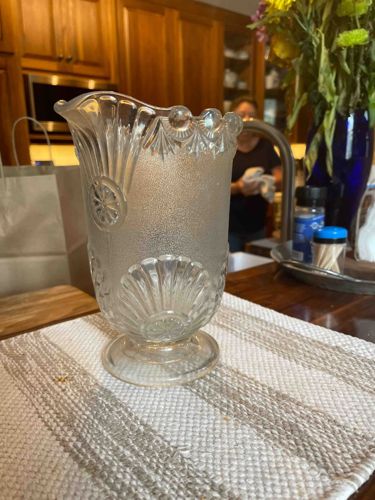
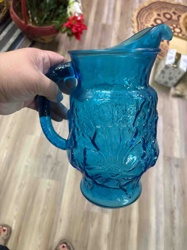
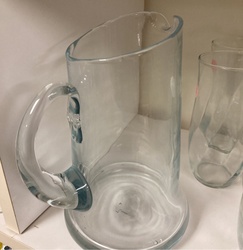
This is a vintage-style pressed glass pitcher, appearing to be clear glass that has been partially frosted, giving it a translucent, somewhat opaque appearance on the main body. The pitcher features a pedestal base and a scalloped rim with decorative elements. The upper rim is adorned with a pattern of alternating raised dots and fanned, shell-like or radial design motifs, which are also repeated on the lower portion of the body, just above the base. There is a distinct circular medallion design on the side of the pitcher, visible on both the left and right in the cropped images, which contains a starburst or floral pattern within. The handle is not fully visible in the images provided, but the lip for pouring is clearly present, with a gentle curve, indicating it is designed for ease of serving. The construction suggests mass production through a molding process, characteristic of pressed glass from the late 19th to early 20th century. The glass exhibits good clarity in the non-frosted, decorative sections, contrasting with the frosted mid-section. There are no obvious chips, cracks, or significant damage visible in the provided images, though standard wear consistent with age and use, such as minor scratches or scuffing, may be present. The estimated capacity is approximately 32 ounces, as per the additional context. The craftsmanship, particularly the detailed pressed patterns, suggests a decent quality piece reflective of its era. This type of glass often falls into the EAPG (Early American Pattern Glass) category or later Victorian/Edwardian pressed glass.
AI Appraisal Report
I have examined the provided images of this pressed glass pitcher with a frosted body and decorative motifs. Based on the visual evidence, the pitcher appears to be a vintage piece, likely dating from the late 19th to early 20th century, consistent with Early American Pattern Glass (EAPG) or a similar Victorian/Edwardian era pressed glass. The partial frosting, scalloped rim, pedestal base, and detailed pressed patterns (including the alternating raised dots, fanned motifs, and circular medallion with a starburst/floral design) are all characteristic of mass-produced decorative glassware from that period. The clarity of the non-frosted areas and the apparent lack of significant damage like chips or cracks suggest it is in good to very good condition, although minor wear consistent with age is to be expected. The estimated 32 oz capacity is noted.
Market conditions for pressed glass of this type are generally stable but not exceptionally strong, unless it's a rare pattern or from a highly sought-after manufacturer. Demand is steady among collectors of antique glassware, particularly EAPG. This specific design does not immediately strike me as one of the more exceedingly rare patterns, which tends to temper its market value. The frosting adds an interesting textural element, which can be appealing.
Factors impacting value include its good apparent condition, the intricate pressed details, and its utilitarian yet decorative nature. However, without knowing the specific pattern name or manufacturer, and given that pressed glass was mass-produced, its rarity level is difficult to ascertain from images alone. A full physical examination would be necessary to confirm the absence of subtle flaws such as hairline cracks, extensive scratching, or manufacturing defects that could affect value. Identification of pattern and manufacturer through in-person inspection or comparison with known EAPG catalogs would significantly aid in achieving a more precise valuation. Provenance documentation, if available, would further enhance authentication and value. Without these, my appraisal is based on general market trends for comparable decorative pressed glass pitchers in good condition.