AI Appraisal Estimate

AI-generated estimates · not official valuations

From the user

What was submitted

Photo and notes provided by the user — not generated by AI

Submitted item photo
Submitted photo · May 27, 2026

User's notes

No additional notes provided.

AI analysis below

AI appraisal

AI analysis & estimate

AI-Generated · Verify before acting

Everything below is generated by AI for informational purposes only. AI can make mistakes — the AI may misidentify items or misattribute them (artist, maker, brand, designer, origin, era). This is not an official valuation and should not be used for insurance, sale, tax, estate, legal, or lending purposes — or any decision requiring a certified appraisal. It is not an authoritative claim about any person, brand, or rights holder — do not share or rely on it as a factual statement about a third party. Always consult qualified professionals before making financial decisions.

Read the full disclaimer

AI Identification

·Not independently authenticated·Verify before acting

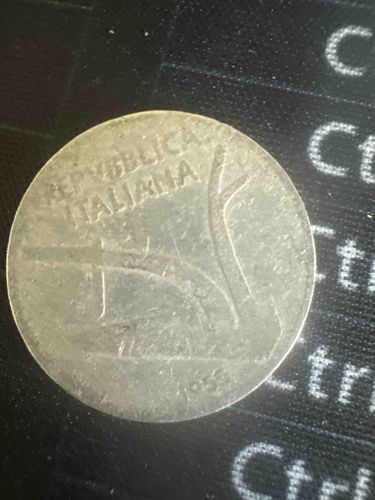
Italian 50 Lire Coin (1959)

Coin

AI Estimated Value

·Not an official valuation·Verify before acting

$1-$5

As of May 27, 2026

AI Item Analysis

·AI can make mistakes·Verify before acting
The item is a circular metallic coin, likely made of an alloy that gives it a silver-gray appearance. Based on the visible inscription 'REPUBBLICA ITALIANA' curved along the top edge, it is a coin from the Italian Republic. The reverse side, which is visible in the image, features a design that appears to be abstract or symbolic, possibly depicting a stylized boat or ship with a prominent mast-like element on the right, and a more horizontal, wave-like or ship-hull-like structure on the left. Faint numeric characters, specifically '1959', are discernible towards the bottom right of the coin, indicating its year of mintage. The surface of the coin exhibits visible signs of wear consistent with circulation, including numerous superficial scratches and scuffs across the fields and high points of the design. There is no significant patina accumulation, suggesting either a recent cleaning or a composition that resists heavy tarnishing. The raised elements of the design, particularly the lettering, show some flattening due to wear, though they remain legible. No distinct mint marks or engraver's signatures are clearly visible from this single image. The craftsmanship appears to be typical of mass-produced coinage. Without specific dimensions, the size is estimated to be standard for a circulating coin of its era. This coin's design, general appearance, and year place it firmly within the mid-20th century, post-World War II period for Italian currency.

AI Appraisal Report

·AI can make mistakes·Verify before acting
I have carefully examined the provided image of the Italian 50 Lire Coin (1959). Based on its visual characteristics, I assess this coin as authentic for its stated type and date. The inscription 'REPUBBLICA ITALIANA' and the distinct stylized ship design are consistent with known examples of the 1959 50 Lire coin. The '1959' date is clearly discernible. The coin's condition is best described as Very Good (VG) to Fine (F) on the Sheldon scale. There are clear signs of circulation wear, including numerous superficial scratches and scuffs across the fields. The raised elements, particularly the lettering and the design details, show significant flattening, though they remain legible. There is no heavy patina, which might suggest a previous cleaning, a factor that generally diminishes numismatic value. From a market perspective, the 1959 Italian 50 Lire is a common year with a high mintage. It is not considered rare. Demand for common-date circulating Italian coinage of this period is generally low among serious collectors, though it holds appeal for type collectors or those interested in modern world coins. Factors significantly impacting its value include its common date, circulated condition, and possible cleaning. Limitations in authenticity verification from an image alone include the inability to properly assess luster, edge condition (which can reveal reeding patterns or mint errors), weight, and specific gravity. A physical inspection would allow for a more precise grading assessment, verification of the alloy's composition, and detection of any subtle alterations or counterfeiting markers not visible in a 2D image. Furthermore, provenance documentation would confirm its history of ownership, adding to its verifiable authenticity.

Get your items appraised

Instant estimates of your treasures with AI-powered appraisals

Browse More Appraisals