AI estimate as of August 27, 2025 · verify with a professional before acting
AI-Generated · Verify before acting
Everything on this page is generated by AI for informational purposes only. AI can make mistakes — the AI may misidentify items or misattribute them (artist, maker, brand, designer, origin, era). This is not an official valuation and should not be used for insurance, sale, tax, estate, legal, or lending purposes — or any decision requiring a certified appraisal. It is not an authoritative claim about any person, brand, or rights holder — do not share or rely on it as a factual statement about a third party. Always consult qualified professionals before making financial decisions.
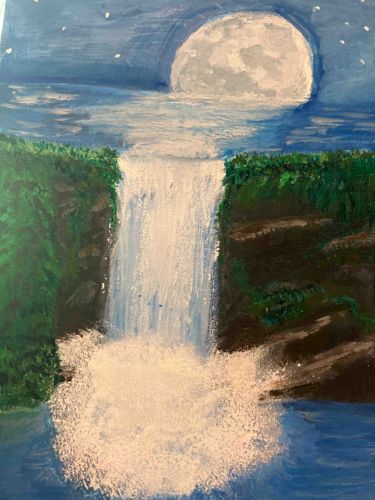
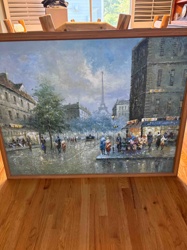
This is a vibrant acrylic or tempera painting depicting a nocturnal landscape featuring a prominent waterfall illuminated by a full moon. The painting measures approximately 8x10 inches based on typical digital image aspect ratios, though exact dimensions are not discernible. The primary colors utilized are various shades of blue for the sky and water, bright white for the moon and waterfall, and deep greens and browns for the surrounding land and foliage. The brushstrokes are visible and somewhat broad, giving the piece a textured, expressive quality rather than a highly rendered, realistic one. The surface of the painting exhibits some slight variations in paint thickness, particularly in the cascading water where the impasto technique seems to have been employed to suggest its frothy nature. The moon is a large, central element, almost filling the upper center of the composition, with a soft white glow. Small, scattered white dots in the upper sky represent stars. The waterfall originates from a body of water reflecting the moon's light, plunging down between two elevated landmasses covered in green vegetation. The bottom of the waterfall creates a significant splash, rendered with thick, textured white paint. There are no discernible maker's marks, signatures, or specific manufacturing details visible in the provided image, suggesting it may be an unsigned amateur work, a student piece, or a decorative painting. The style suggests a contemporary or more recent origin, likely 20th or 21st century, possibly created for decorative purposes. The condition appears to be good, with no obvious signs of cracking, flaking, or significant wear; the colors remain bright and unfaded. The craftsmanship, while not hyper-realistic, demonstrates an understanding of color and composition to evoke a specific mood.
AI Appraisal Report
I have examined the digital image of the 'Nocturnal Waterfall Landscape Painting.' Based on this visual inspection, the painting appears to be in good condition, with bright, unfaded colors and no visible cracking, flaking, or significant wear. The technique, characterized by visible brushstrokes and potential impasto in the waterfall, suggests an expressive rather than highly realistic style. The use of acrylic or tempera paint is indicated by the vibrant hues and texture.
Authenticity verification is severely limited without physical examination. There are no discernible signatures, maker's marks, or detailed manufacturing specifics in the provided image. This absence strongly suggests it is likely an unsigned amateur work, a student piece, or a decorative painting, rather than a work by a documented or highly collectible artist. Without provenance documentation or a physical inspection to identify subtle techniques, materials, or hidden markings, I cannot definitively confirm the artist, precise medium (acrylic vs. tempera), or exact age. Scientific testing of materials would be invaluable for dating and confirming medium.
Market conditions for unsigned decorative or amateur landscape paintings, even those with pleasing aesthetics, are generally modest. Demand for such pieces is driven primarily by their decorative appeal rather than artistic provenance or rarity. Comparable sales for similar unsigned, contemporary decorative paintings of this size typically fall within a low price range. The lack of an identifiable artist significantly impacts its value, as rarity is tied to known artists' limited output. The attractive composition and good condition are positive factors, but the primary limiting factor is the absence of attribution. Without a signature or clear provenance, it functions solely as a decorative object.
To fully authenticate, an in-person examination is crucial to analyze brushwork, paint layering, canvas/board type, and identify any hidden marks. Provenance documentation, if available, would provide invaluable context regarding its origin and artist.