AI Appraisal Estimate

AI-generated estimates · not official valuations

From the user

What was submitted

Photo and notes provided by the user — not generated by AI

Submitted item photo
Submitted photo · June 23, 2026

User's notes

No additional notes provided.

AI analysis below

AI appraisal

AI analysis & estimate

AI-Generated · Verify before acting

Everything below is generated by AI for informational purposes only. AI can make mistakes — the AI may misidentify items or misattribute them (artist, maker, brand, designer, origin, era). This is not an official valuation and should not be used for insurance, sale, tax, estate, legal, or lending purposes — or any decision requiring a certified appraisal. It is not an authoritative claim about any person, brand, or rights holder — do not share or rely on it as a factual statement about a third party. Always consult qualified professionals before making financial decisions.

Read the full disclaimer

AI Identification

·Not independently authenticated·Verify before acting

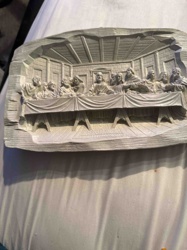
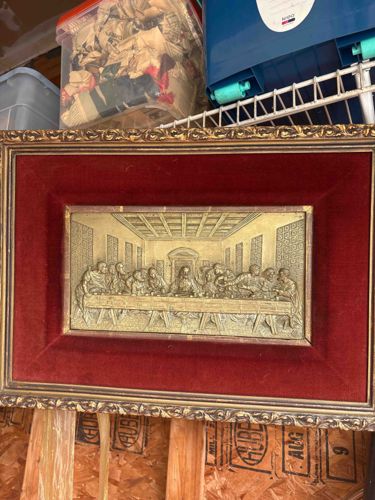
Gilt Metal Bas-Relief Plaque of 'The Last Supper' in Red Velvet Matting

Religious Art & Collectibles

AI Estimated Value

·Not an official valuation·Verify before acting

$150 - $250

As of June 23, 2026

AI Item Analysis

·AI can make mistakes·Verify before acting
This item is a dimensional bas-relief plaque depicting Leonardo da Vinci's iconic 'The Last Supper.' The central artwork is likely made of a cast metal, such as pewter or bronze, with a gold-toned finish or gilding applied to the surface. It is rectangular in orientation with detailed renderings of Jesus and the twelve apostles arranged across a single table, set against a classic architectural interior with visible ceiling beams and windows. The plaque is inset into a deep-set, beveled matting covered in a rich, burgundy-red velvet fabric, which provides a dramatic contrast to the metallic subject. The outermost border is an ornate, gilded wood or composite frame featuring scrolled acanthus leaf motifs and a decorative beaded inner lip. In terms of condition, there is visible dust accumulation across the velvet matting and minor wear to the gilt finish on the frame's raised edges, suggesting it dates from the mid-to-late 20th century. The craftsmanship is consistent with high-quality religious commemorative art from this period, often intended for home or parish display. There are no immediately visible maker's marks on the front, though such pieces' origins are often labeled on the reverse of the frame or indicated by a small signature in the lower corner of the cast metal.
AI Appraisal Report

·AI can make mistakes·Verify before acting
Based on my visual examination of the gilt metal bas-relief depicting 'The Last Supper,' I have determined this piece to be a high-quality religious commemorative work typical of the mid-20th century (circa 1950–1970). The cast metal plaque exhibits fine detailing in the drapery and facial expressions of the apostles, suggesting a well-maintained production mold. The application of the gold-toned finish is consistent with electroplated gilding used in mass-produced liturgical art of this era. The condition is fair to good; while the metalwork remains vibrant, the red velvet matting shows significant dust accumulation and potential UV-fading, which is common for textiles of this age. Professional cleaning of the velvet and minor restoration to the frame's acanthus leaf motifs would be required to achieve the higher end of the valuation range. The market for mid-century religious bas-reliefs remains stable, driven primarily by collectors of Catholic iconography and interior decorators seeking traditional focal pieces. This specific format—a gilded relief against a deep velvet shadowbox—was widely produced by manufacturers in Italy and the United States, making it a common find rather than a rare specimen. Limitations of this appraisal include the inability to inspect the reverse for manufacturer stamps (such as 'Alva Museum Replicas' or Italian foundry marks) or to test the metal composition. To definitively confirm authenticity and origin, an in-person inspection of the weight, the attachment method of the plaque, and a search for a hidden artist signature in the lower cast margin would be necessary. Documentation of provenance or an original sales receipt would also assist in refining the historical pedigree.

Get your items appraised

Instant estimates of your treasures with AI-powered appraisals

Browse More Appraisals