AI estimate as of December 16, 2025 · verify with a professional before acting
AI-Generated · Verify before acting
Everything on this page is generated by AI for informational purposes only. AI can make mistakes — the AI may misidentify items or misattribute them (artist, maker, brand, designer, origin, era). This is not an official valuation and should not be used for insurance, sale, tax, estate, legal, or lending purposes — or any decision requiring a certified appraisal. It is not an authoritative claim about any person, brand, or rights holder — do not share or rely on it as a factual statement about a third party. Always consult qualified professionals before making financial decisions.
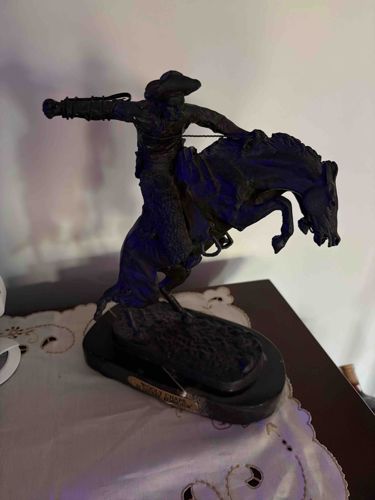
This item is a detailed sculpture depicting a cowboy in the midst of a rodeo event, specifically riding a bucking bronco. The material appears to be a metal, likely bronze or a bronze-finished resin, judging by its dark, somewhat metallic sheen and the way light reflects off its surfaces. The overall color is a dark, almost black-bronze, with subtle variations that suggest depth and age. The cowboy figure is dynamically posed, leaning back with one arm outstretched, presumably holding a rope or strap, demonstrating the classic rodeo stance of balance and control. He is wearing a wide-brimmed hat, chaps, and what appear to be cowboy boots, all rendered with textural details. The bucking horse is captured mid-air, with its front legs kicked up and its head down, conveying intense movement and power. Details on the horse, such as its mane and muscle definition, are well-articulated. The entire dynamic scene is mounted on a multi-tiered base. The uppermost part of the base, directly beneath the horse's back legs and the cowboy's chaps, has a textured, possibly rocky or dirt-like finish, adding to the realism of the rodeo scene. This textured section is then affixed to a smooth, rectangular lower base, which appears to be made of a polished, dark stone or a similar material. A small, brass-colored plaque is visible on the front of this lower base, which likely displays the title of the piece, the artist's name, or a dedication. From the visible details, the craftsmanship appears to be of good quality, with attention paid to the expressive poses and textural elements. There are no obvious signs of significant damage, wear, or repairs visible in the provided image; the piece seems to be in good, well-maintained condition. This style of sculpture, often depicting Western themes, was popular from the late 19th century through the 20th century and continues to be. The dark finish suggests it could be an older piece or a modern reproduction with an antique aesthetic.
AI Appraisal Report
This bronze-tone sculpture depicting a cowboy on a bucking bronco presents as a well-executed piece with strong visual appeal. Based on visual examination from the provided image, the condition appears excellent, with no visible damage, chips, or significant wear. The dark, metallic sheen suggests either a bronze alloy or a bronze-finished resin, a material distinction that significantly impacts value but cannot be definitively determined without physical inspection. The dynamic posing of both the cowboy and the horse, along with the detailed musculature, hat, chaps, and the textured base, all speak to good craftsmanship.
Market conditions for Western-themed sculptures, particularly those depicting rodeo scenes, remain consistent among collectors and enthusiasts of Western art. While not exceedingly rare, pieces that capture such energy and detail consistently find buyers. The presence of a plaque suggests a potential artist or title, which, if identifiable, could influence value. Comparables for bronze-finished resin sculptures of this size and detail typically fall within the $150-$300 range, while genuine solid bronze pieces of similar quality by recognized artists could command $500 to several thousand dollars.
My primary limitation in providing a more precise valuation is the inability to determine the material composition. Without a physical examination to ascertain if this is solid bronze, bronze-clad, or a bronze-finished resin, the authenticity as a true bronze artwork cannot be confirmed. An in-person inspection would allow for weight assessment, examination of patina, and potentially testing of the metal composition. Additionally, researching any inscription on the plaque would be crucial for artist attribution and provenance documentation, which are key factors in establishing authenticity and maximizing value.