AI estimate as of December 14, 2025 · verify with a professional before acting
AI-Generated · Verify before acting
Everything on this page is generated by AI for informational purposes only. AI can make mistakes — the AI may misidentify items or misattribute them (artist, maker, brand, designer, origin, era). This is not an official valuation and should not be used for insurance, sale, tax, estate, legal, or lending purposes — or any decision requiring a certified appraisal. It is not an authoritative claim about any person, brand, or rights holder — do not share or rely on it as a factual statement about a third party. Always consult qualified professionals before making financial decisions.
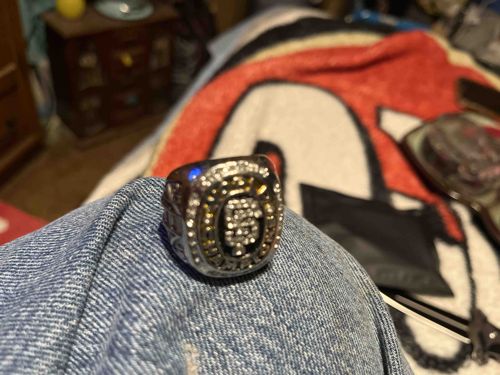
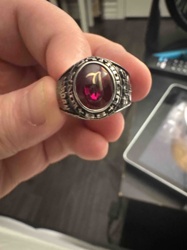
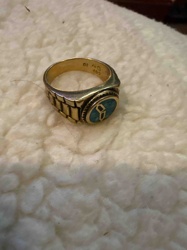
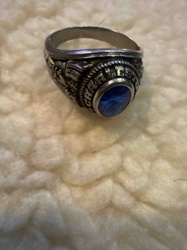
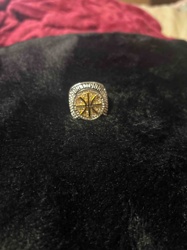
This is a large, ornate commemorative ring, likely fashioned in the style of a championship or achievement ring. The ring appears to be constructed from a base metal, possibly silver-toned alloy, with a polished, shiny finish. The top face of the ring is prominent and features a central design that includes a letter 'P' or similar initial, possibly encircled, set against a dark enamel or stone background. This central element is surrounded by multiple rows of small, clear, faceted stones, likely rhinestones or cubic zirconia, which provide significant sparkle. Additionally, there are sections of smaller, golden-toned stones or accents that create a contrast with the clear stones. The sides of the ring (shanks) are also adorned with intricate detailing, though specific motifs are not clearly discernible in this image. The overall construction suggests a robust, substantial piece, designed to make a statement. There are no immediately apparent signs of significant wear, damage, or repairs from the visible angles, and the stones appear to be intact. The ring’s style aligns with modern commemorative jewelry, often associated with sports championships, academic achievements, or organizational milestones. The craftsmanship appears to be commercially produced, with a focus on eye-catching design through the use of multiple stones and metallic accents. It projects a strong sense of accomplishment or affiliation. Given its design commonality with sports rings, it likely dates from the late 20th or 21st century.
AI Appraisal Report
Upon visual examination of this Commemorative Championship-Style Ring, I assess its condition as excellent, showing no discernible signs of significant wear, damage, or missing stones. The setting and adornments appear intact. Authenticity, based solely on the image, points to a commercially produced commemorative piece. The materials appear to be base metal with cubic zirconia or rhinestones, and possibly gold-toned plating on some accents, rather than precious metals and genuine gemstones. This is typical for such statement rings designed for widespread distribution, often associated with sports, corporate, or academic achievements.
Market conditions for commemorative rings of this style are generally stable, with demand driven primarily by sentimental value to the original recipient or affinity group. Comparables largely include other mass-produced championship-style rings, which typically retail in the $50-$200 range, depending on complexity and perceived quality. The presence of a prominent initial ('P') suggests a specific affiliation, which might enhance value for someone connected to that organization, but it does not appear to be a rare or historically significant piece. Factors significantly impacting value are the non-precious materials and commercial production. The aesthetic is eye-catching, which contributes to its marketability as a costume or commemorative item.
It is crucial to note the limitations of authenticity verification from images alone. Without physical inspection, I cannot confirm the exact metal composition (e.g., sterling silver vs. plated base metal), the type of stones (e.g., cubic zirconia vs. glass), or the quality of the plating. An in-person examination would allow for precise material identification through testing (e.g., specific gravity, acid tests for metal, refractometer for stones). Provenance documentation, such as original purchase receipts or association with a known event, would also be vital for full authentication and to ascertain any potential historical significance which could alter its appraisal.