AI Appraisal Estimate

AI-generated estimates · not official valuations

From the user

What was submitted

Photo and notes provided by the user — not generated by AI

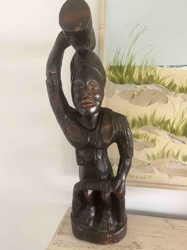
Submitted item photo
Submitted photo · May 23, 2026

User's notes

houten beeld

AI analysis below

AI appraisal

AI analysis & estimate

AI-Generated · Verify before acting

Everything below is generated by AI for informational purposes only. AI can make mistakes — the AI may misidentify items or misattribute them (artist, maker, brand, designer, origin, era). This is not an official valuation and should not be used for insurance, sale, tax, estate, legal, or lending purposes — or any decision requiring a certified appraisal. It is not an authoritative claim about any person, brand, or rights holder — do not share or rely on it as a factual statement about a third party. Always consult qualified professionals before making financial decisions.

Note

This analysis also relies on unverified notes provided by the user, which may be incomplete or inaccurate and could affect the result.

Read the full disclaimer

AI Identification

·Not independently authenticated·Verify before acting

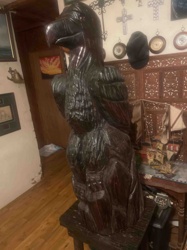
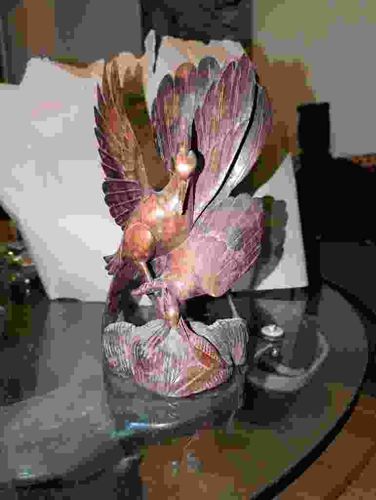
Indo-Chinese Carved Hardwood Bird Sculpture

Antique & Vintage Wooden Sculpture

AI Estimated Value

·Not an official valuation·Verify before acting

$150 - $250

As of May 23, 2026

AI Item Analysis

·AI can make mistakes·Verify before acting
This is a hand-carved hardwood sculpture depicting an avian subject, likely a crane or pheasant, in a dynamic upward-soaring pose. The piece is crafted from a dense, dark-grained wood with a notable reddish-brown patina, commonly associated with rosewood or hibiscus wood (often referred to as 'Suar' or 'Bali Wood' in some regions). The sculpture features intricate openwork carving, particularly in the splayed wings and the base, which is stylized to represent naturalistic clouds or rocky terrain. The feathers exhibit deep, vertical striations which add a textural complexity to the piece. The construction appears to be a single block of wood, though the wings are carved with such thinness that they possess a translucent quality at the edges. Regarding condition, there is visible dust accumulation within the deep crevices of the carvings, and minor surface abrasions are present on the most prominent wingtips. No major structural fractures or repairs are immediately evident from the front view, though natural wood-grain checking may be present due to age. This style is consistent with mid-to-late 20th-century craftsmanship from Southeast Asia or Southern China, demonstrating high levels of manual dexterity and attention to fluid, organic movement. The balance of the piece is well-engineered, with the weight of the sprawling wings centered over a consolidated base.
AI Appraisal Report

·AI can make mistakes·Verify before acting
Based on my examination of this hand-carved hardwood sculpture, I have identified it as a mid-20th-century decorative piece, likely of Southeast Asian origin. The craftsmanship demonstrates the 'fluid-motion' style popular in the 1960s and 70s, utilizing dense, fine-grained hardwood such as rosewood or suar. The openwork carving on the wings is particularly well-executed, showing significant manual dexterity. Upon close inspection, the reddish-brown patina appears consistent with natural aging rather than topical staining, which enhances its aesthetic appeal. The condition is generally good, though the minor abrasions on the wingtips and the dust accumulation in the deep striations suggest it has been displayed for many years without specialized cleaning. These factors slightly depress the value but are common for items of this vintage. Market demand for this specific style has stabilized; while 'Orientalist' wood carvings were highly sought after decades ago, modern collectors now prioritize signed pieces or those with documented provenance from specific known masters of the era. Comparables for unsigned, medium-scale avian hardwood sculptures typically realize prices between $100 and $300 at auction or within specialized vintage markets. Value is bolstered by the fact that it appears to be carved from a single block. However, please note that from digital images alone, I cannot definitively confirm the wood species or rule out internal 'shaking' (natural splits) that may be hidden in the base. A full authentication would require an in-person macroscopic wood grain analysis to identify the specific genus and a tactile inspection to ensure no structural adhesives or repairs are masked by the dark patina.

Get your items appraised

Instant estimates of your treasures with AI-powered appraisals

Browse More Appraisals