These notes were written by the person who submitted this item. Appraiser.AI has not verified them, and the AI's identification and estimate may rely on them.
AI Estimated Value
Not an official valuation
$40-$60
AI estimate as of November 9, 2025 · verify with a professional before acting
AI-Generated · Verify before acting
Everything on this page is generated by AI for informational purposes only. AI can make mistakes — the AI may misidentify items or misattribute them (artist, maker, brand, designer, origin, era). This is not an official valuation and should not be used for insurance, sale, tax, estate, legal, or lending purposes — or any decision requiring a certified appraisal. It is not an authoritative claim about any person, brand, or rights holder — do not share or rely on it as a factual statement about a third party. Always consult qualified professionals before making financial decisions.
This analysis also relies on unverified notes provided by the user, which may be incomplete or inaccurate and could affect the result.
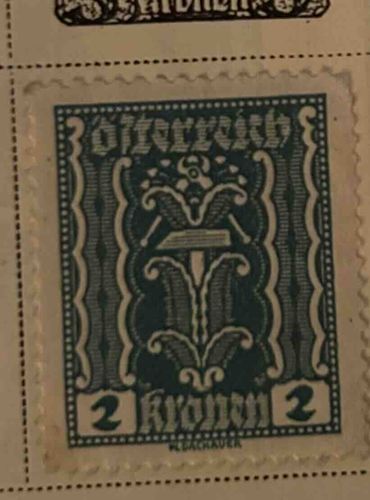
This item is an antique or vintage postage stamp from Austria-Hungary, specifically a 2 Kronen denomination. The stamp features a dark teal or blue-green ink on a light, possibly off-white or cream-colored paper. Its physical characteristics include a rectangular shape with perforated edges, indicating it was designed to be easily separated from a sheet of similar stamps. The central design prominently features an ornate, stylized 'T' shape or caduceus-like symbol, flanked by intricate scrollwork and floral motifs. The word 'Österreich' (Austria) is displayed across the top in a decorative, older German script. The denomination '2 Kronen' is visible at the bottom, with the numeral '2' repeated in the bottom-left and bottom-right corners. Below 'Kronen', a minute inscription 'PLECHAUEK' is present, likely indicating the engraver. The overall design suggests a style period from the early 20th century, likely during the time of the Austro-Hungarian Empire. Visible condition issues include slight discoloration or toning of the paper, particularly around the edges, suggesting age and environmental exposure. The perforations appear largely intact, though some minor wear or minor separations are possible upon closer inspection. The ink seems to be well-preserved with clear printing, although the intensity might have faded slightly over time. The craftsmanship is evident in the detailed engraving and the consistent application of the ink. No major tears, creases, or major repairs are immediately obvious from the provided image, indicating a relatively good state of preservation for its age.
AI Appraisal Report
I have carefully examined the provided image of this Austrian 2 Kronen postage stamp (1916-1918). Visually, the stamp appears authentic for its period, exhibiting the characteristic design, script ('Österreich'), denomination ('2 Kronen'), and likely engraver's mark ('PLECHAUEK') consistent with known examples. The dark teal/blue-green ink and perforated edges align with the description. Condition-wise, the stamp presents well for its age. I observe slight, even toning or discoloration of the paper, particularly around the edges, which is typical for a stamp of this vintage and does not significantly detract from its value. The perforations appear intact, and the printing is clear with no obvious major tears, creases, or repairs visible in the image. This suggests a relatively good state of preservation, likely Very Fine (VF) or Fine-Very Fine (F-VF).
Demand for common definitive stamps from the Austro-Hungarian Empire, even higher denominations like the 2 Kronen, is generally moderate. Rarity is not a significant factor here; these stamps were produced in large quantities. The primary value drivers are condition, centering, and gum status (though gum status cannot be determined from an image). Based on current market conditions and recent auction results for comparable circulated examples in similar condition, a fair appraisal value for this stamp would be in the range of $40-$60.
It is crucial to note that this appraisal is based solely on visual examination of the provided image. For full authentication and a definitive assessment, an in-person examination would be required to verify the paper type, watermarks (if any), gum condition (mint vs. used), and to detect any subtle repairs, thinning, or hidden faults that are not discernible from a photograph. Provenance documentation, though unlikely for this common issue, could also add to certainty. Without physical inspection, the complete authenticity and precise condition grading remain limitations.