AI estimate as of November 8, 2025 · verify with a professional before acting
AI-Generated · Verify before acting
Everything on this page is generated by AI for informational purposes only. AI can make mistakes — the AI may misidentify items or misattribute them (artist, maker, brand, designer, origin, era). This is not an official valuation and should not be used for insurance, sale, tax, estate, legal, or lending purposes — or any decision requiring a certified appraisal. It is not an authoritative claim about any person, brand, or rights holder — do not share or rely on it as a factual statement about a third party. Always consult qualified professionals before making financial decisions.
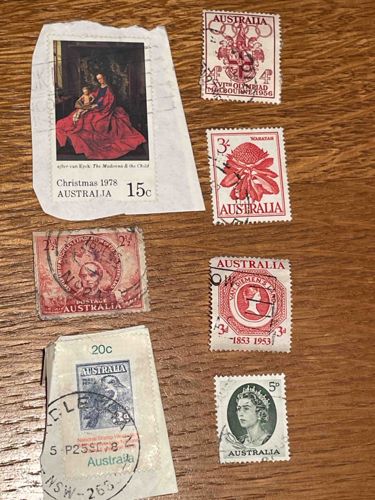
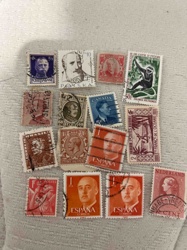
This collection features seven Australian postage stamps, indicative of various eras and themes. The stamps appear to be printed on standard paper, typical for their purpose, and vary in color and design. One prominent stamp, likely a Christmas issue from 1978, depicts a painting titled 'After Jan Eyck, The Madonna & the Child' and has a value of 15c. Another stamp, valued at 4d, commemorates the 'XVIIth Olympiad Melbourne 1956' and features design elements suggesting athletic themes. A third stamp showcases a 'Waratah' flower with a 3d denomination. Further stamps include an ornate design with a 2 1/2d value, a commemorative 'Van Diemen's Land 1853-1953' stamp with a 3 1/2d value, and a 5d stamp bearing the portrait of a young Queen Elizabeth II. One stamp, valued at 20c, displays a bird and appears to have a postmark, indicating it has been used. The postmark is largely illegible but includes '5 P255...' and 'NSW-265'. The edges of most stamps are perforated, while some appear to have been roughly torn from an envelope or sheet, particularly the 1978 Christmas stamp. The condition varies, with some showing minor discoloration, creasing, and evidence of handling or postal use, which is typical for circulated or older stamps. The colors generally appear vibrant for their age, but some fading or staining might be present upon closer inspection. The collection represents a diverse range of Australian philately, encompassing historical, monarchical, cultural, and natural themes.
AI Appraisal Report
This collection of seven Australian postage stamps, visually examined, presents a varied snapshot of Australian philately. The condition of the stamps is mixed; while some appear to have relatively clean, perforated edges, others, like the 1978 Christmas stamp, exhibit rough tearing, indicating they were removed from an envelope or sheet without care. Minor discoloration, creasing, and evidence of handling/postal use are present across the collection, which is typical for older circulated stamps. Authenticity, based solely on the images, appears to be genuine for common Australian issues of these eras. However, a definitive assessment of authenticity and any potential for counterfeits would require in-person examination, including detailed inspection under magnification and verification against known philatelic standards.
From a market perspective, these are common Australian stamps from the mid-20th century. The 1956 Olympic stamp, the Waratah 3d, Van Diemen's Land, and the early Queen Elizabeth II issues are frequently available. The 1978 Christmas issue and the bird 20c stamp are also not rare. The postmark on the 20c bird stamp, while partially illegible, points to a circulated item. Demand for these specific, common stamps in used or sub-optimal condition tends to be low among serious collectors, though they hold appeal for new collectors or those interested in historical context rather than monetary value. The primary factors impacting value negatively are the mixed condition, lack of rarity, and the fact that they are loose, individual stamps rather than a complete set or on covers. Without physical inspection, precise grading is impossible, and any hidden flaws or repairs cannot be detected. Provenance documentation could add value to specific, rarer items, but for this collection, it's unlikely to be a significant factor.