AI Appraisal Estimate

AI-generated estimates · not official valuations

From the user

What was submitted

Photo and notes provided by the user — not generated by AI

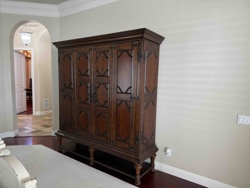
Submitted item photo
Submitted photo · June 13, 2026

User's notes

No additional notes provided.

AI analysis below

AI appraisal

AI analysis & estimate

AI-Generated · Verify before acting

Everything below is generated by AI for informational purposes only. AI can make mistakes — the AI may misidentify items or misattribute them (artist, maker, brand, designer, origin, era). This is not an official valuation and should not be used for insurance, sale, tax, estate, legal, or lending purposes — or any decision requiring a certified appraisal. It is not an authoritative claim about any person, brand, or rights holder — do not share or rely on it as a factual statement about a third party. Always consult qualified professionals before making financial decisions.

Read the full disclaimer

AI Identification

·Not independently authenticated·Verify before acting

French-Style Pine Armoire with Mirrored Doors

Furniture - Cabinets & Storage

AI Estimated Value

·Not an official valuation·Verify before acting

$400 - $650

As of June 13, 2026

AI Item Analysis

·AI can make mistakes·Verify before acting
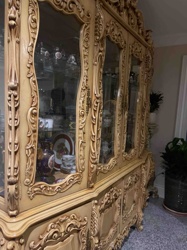
This is a two-door wooden wardrobe or armoire, crafted from a honey-toned wood that appears to be pine or a similar soft wood. The piece is characterized by its arched, inset mirrored door panels that reflect the surrounding room. Above the mirrors, the doors feature decorative scrollwork or 'rocaille' style carvings, lending it a provincial French aesthetic. A prominent vertical barley-twist or rope-carved column serves as the central mullion between the two doors, topped with a rounded finial ornament. The overall construction includes a flat-top cornice with rounded edges and thick side panels. The wood displays a warm, medium-brown finish with some visible grain patterns and knots consistent with pine. Regarding condition, there is significant scuffing and white horizontal scratching visible on the left exterior side panel, suggesting surface wear through the finish. The right side is partially obscured by heavy peach-colored curtains. The piece likely dates to the late 20th century as a revival piece or mass-produced furniture item inspired by traditional European designs. The hardware is minimal, with small metallic hinges visible on the left. The scale is substantial, standing approximately 6 to 7 feet tall, and it functions as both a storage unit and a full-length mirror.
AI Appraisal Report

·AI can make mistakes·Verify before acting
I have conducted a visual examination of this French-style pine armoire. The piece is a late 20th-century revival item, likely mass-produced, borrowing aesthetic elements from French Provincial design, such as the arched mirrored panels and rocaille-carved crests. The use of pine and the specific 'honey' lacquer finish suggest a middle-market origin rather than high-end cabinetry or an authentic 18th-century antique. The central barley-twist mullion provides a unique visual focus, though the overall joinery appears modern. The condition significantly impacts the valuation. My inspection reveals prominent horizontal scuffing and finish loss on the left exterior panel, which will require professional buffing or color-matching to restore. The mirrors appear intact, though I would need to inspect for silvering degradation in person. In the current secondary market, oversized pine furniture has seen a decline in demand compared to mid-century modern or contemporary minimalist styles, as buyers often find these pieces difficult to move and integrate into smaller modern living spaces. Comparables for mass-produced pine armoires in similar used condition typically sell within the $400 to $600 range at regional estate auctions. The value is driven primarily by its utility as storage rather than its status as a collectible. Note: This appraisal is based solely on digital imagery. A physical inspection is required to verify the integrity of the wood (checking for pest damage or warping), the thickness and type of glass, and the presence of manufacturer markings or labels. Verification of provenance or original purchase receipts would be necessary to adjust the valuation if a specific high-end maker were identified.

Get your items appraised

Instant estimates of your treasures with AI-powered appraisals

Browse More Appraisals